What Is the Cost of a 3D Printer? Complete Price Guide for Every Budget (2026)
The cost of a 3D printer in India typically ranges from ₹12,000 to over ₹1 crore, depending on the printer type, printing technology, build volume, material compatibility, and intended application. Entry-level FDM printers for beginners generally cost between ₹12,000 and ₹30,000, while professional resin and engineering-grade machines range from ₹50,000 to ₹2 lakh. Industrial SLS, SLM, and metal 3D printers can cost anywhere from ₹7 lakh to ₹1 crore or more.
However, the purchase price is only part of the investment. The total cost of owning a 3D printer also includes filament or resin, spare parts, maintenance, electricity, software, post-processing tools, and ongoing operating expenses. Understanding these costs helps you choose a machine that fits both your budget and production requirements.
In this guide, you’ll find a complete breakdown of 3D printer cost by printer type, technology, industry, and use case, along with the factors that influence pricing and the hidden costs many buyers overlook before making a purchase.
What Is the Cost of a 3D Printer?
Here’s a fast reference before we go deeper into each category.
| Printer Category | Typical Price Range (India) | Best Suited For |
|---|---|---|
| Entry-level Desktop FDM | ₹12,000 – ₹30,000 | Students, beginners, hobbyists |
| Mid-range / Professional FDM | ₹30,000 – ₹2 lakh | Small businesses, designers, engineers |
| Resin (SLA/DLP/LCD) | ₹15,000 – ₹1.5 lakh | Miniatures, jewellery, dental models |
| Industrial SLS | ₹7 lakh – ₹25 lakh+ | Functional prototyping, low-volume production |
| Metal 3D Printers | ₹25 lakh – ₹1 crore+ | Aerospace, automotive, medical implants |
As this table shows, the cost of a 3D printer scales sharply with capability. A machine that prints a simple PLA bracket costs a fraction of one that prints load-bearing titanium parts.
Why Does the Cost of a 3D Printer Vary?
3D printer cost isn’t arbitrary. Manufacturers price machines based on measurable engineering differences, and understanding these factors helps you avoid overpaying or underbuying.
- Printing technology: FDM machines extrude melted plastic and are the cheapest to build. Resin and laser-based systems need optics, galvanometers, and precision components that raise the price.
- Build volume: A printer that can produce a 300mm part costs more than one limited to 150mm, since it needs a larger frame, longer rails, and more powerful motors.
- Speed: High-speed printers use stiffer frames, lighter print heads, and better cooling, all of which add to manufacturing cost.
- Accuracy and layer resolution: Tighter tolerances require better stepper motors, linear rails, and calibration sensors.
- Supported materials: A printer that only handles PLA is simpler than one built to survive the heat and fumes of ABS, nylon, or carbon-fiber composites.
- Software: Bundled slicer software is usually free, but advanced features like AI failure detection or fleet management often come at a premium.
- Automation: Auto bed leveling, automatic material changing, and remote monitoring reduce manual work but increase the bill of materials.
- Brand reputation and warranty: Established brands charge more because they back the printer with parts availability, firmware updates, and after-sales support.
3D Printing Machine Price by Technology
Not all 3D printers work the same way, and the printing machine price in India varies enormously by technology.
FDM Printer Cost
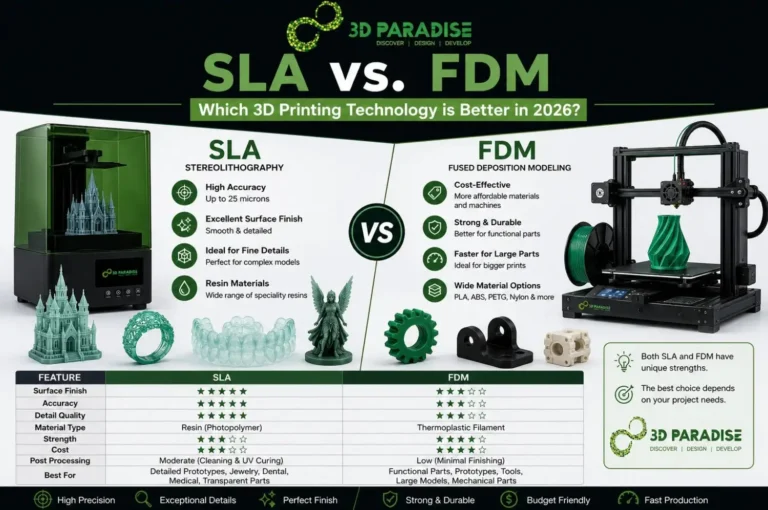
Fused deposition modeling is the most common and most affordable technology. Entry-level FDM printers start around ₹12,000, while enclosed, engineering-grade FDM machines capable of printing ABS, ASA, and polycarbonate can cost ₹50,000 to ₹2 lakh.
Resin Printer Cost
Resin printers (using LCD/MSLA technology) cost anywhere from ₹15,000 for compact desktop units to ₹1.5 lakh for larger, higher-resolution machines used for jewelry casting and dental models.
SLA Printer Cost
Stereolithography printers use a laser instead of an LCD screen for curing resin, delivering finer detail. Professional SLA systems typically start around ₹3–5 lakh and can exceed ₹15 lakh depending on build volume and accuracy.
SLS Printer Cost
Selective Laser Sintering machines sinter nylon powder with a laser and don’t need support structures. Entry-level SLS systems with smaller build volumes start around ₹7 lakh, while industrial units can reach ₹25 lakh or more.
Metal 3D Printer Cost
Metal printers using DMLS or SLM technology are the most expensive category, generally starting at ₹25–30 lakh and going well past ₹1 crore for aerospace-grade systems with multiple lasers and inert-gas chambers.
Table: 3D Printer Price by Technology
| Technology | Entry Price | Professional/Industrial Price |
|---|---|---|
| FDM | ₹12,000 | ₹2 lakh |
| Resin (SLA/LCD) | ₹15,000 | ₹1.5 lakh |
| SLA (Laser) | ₹3 lakh | ₹15 lakh+ |
| SLS | ₹7 lakh | ₹25 lakh+ |
| Metal (DMLS/SLM) | ₹25 lakh | ₹1 crore+ |
3D Printer Cost in India by Budget
Here’s how the market breaks down by budget bracket, along with who each range suits best.
| Budget Range | What You Get | Ideal For |
|---|---|---|
| Under ₹30,000 | Basic FDM printers, smaller build volume, manual leveling on cheaper models | Students, absolute beginners |
| ₹30,000–₹70,000 | Auto-leveling FDM, multi-material support, better print speed | Hobbyists, makers, small design studios |
| ₹70,000–₹2 lakh | Enclosed FDM or professional resin printers, engineering materials | Product designers, engineering teams, startups |
| ₹2 lakh–₹10 lakh | Entry industrial machines, larger SLA/SLS systems | Manufacturing units, service bureaus, educational institutes |
| ₹10 lakh+ | Full industrial SLS and metal printers | Aerospace, automotive, medical device manufacturers |
What Additional Costs Should You Consider Before Buying a 3D Printer?
The sticker price is only the starting point. Total cost of ownership (TCO) includes several recurring expenses that catch first-time buyers off guard.
- Filament cost: PLA and PETG typically cost ₹1,200–₹2,500 per kg, while specialty filaments like nylon, TPU, and carbon-fiber blends cost significantly more.
- Resin cost: Standard resins run ₹2,000–₹4,000 per liter, with engineering and dental resins priced higher.
- Electricity: Most FDM printers draw 120–250W. Even long prints usually add only ₹5–50 to your electricity bill, so this is rarely a deciding factor.
- Maintenance: Nozzles, belts, and bed surfaces wear out over time. Budget ₹500–₹3,000 a few times a year for consumables and repairs.
- Spare parts: Hotends, extruder gears, and LCD screens (for resin printers) need periodic replacement, especially with heavy use.
- Software: Basic slicers are free, but professional CAD and fleet-management software can cost thousands per year in licensing.
- Failed prints: Even experienced users lose 5–10% of prints to warping, adhesion issues, or power fluctuations. Factor this material waste into your budget.
- Safety equipment: Resin printing requires gloves and ventilation; some materials like ABS benefit from an enclosure and fume extraction.
Calculating total cost of ownership, rather than just the upfront machine price, gives you a far more realistic picture of what owning a 3D printer actually costs over one to three years.
Best Low Cost 3D Printer: Is It Worth Buying?
Budget 3D printers under ₹20,000 have improved dramatically. Machines that once required constant manual calibration now include auto bed leveling, direct-drive extruders, and reliable firmware as standard.
Pros:
- Low upfront investment
- Large community support and abundant tutorials
- Good enough quality for prototypes, brackets, and hobby projects
Cons:
- Smaller build volume
- Fewer supported materials
- More manual troubleshooting compared to premium models
Ideal users: Students, first-time hobbyists, and anyone testing whether 3D printing fits their workflow before committing to a bigger investment.
Upgrade path: Many low-cost printers support aftermarket upgrades like all-metal hotends, better bed surfaces, and enclosures, letting you extend the printer’s capability without buying a new machine immediately.
Should You Buy a 3D Printer or Use a 3D Printing Service?
This is one of the most overlooked decisions in the buying process, and it often matters more than which printer you choose.
| Factor | Buying a Printer | Using a 3D Printing Service |
|---|---|---|
| Upfront Cost | High | None |
| Cost per Part | Low at high production volume | Higher per part, but no fixed investment |
| Maintenance | Your responsibility | Handled by the service provider |
| Turnaround Time | Immediate, in-house production | Depends on the provider’s production queue |
| Access to Technology | Limited to the printers you own | Access to FDM, SLA, SLS, and metal 3D printing on demand |
If you print occasionally or need access to technologies like SLS or metal printing without a lakh-level investment, outsourcing to a provider like Paradise-3D often works out cheaper and more flexible than owning a machine. If you print daily and the volume is high, owning a printer usually pays for itself faster.
How to Choose the Right 3D Printer Based on Your Budget
Different users have different priorities. Here’s how to think about the decision to buy a 3D printer based on who you are.
Students: Prioritize a low-cost FDM printer with strong community support and easy troubleshooting.
Hobbyists: Look for auto-leveling, decent build volume, and multi-material compatibility so you can experiment freely.
Designers: Consider resin printers for detail work, or enclosed FDM machines for functional prototypes.
Engineers: Look for engineering-grade material support (nylon, polycarbonate, carbon fiber) and tighter tolerances.
Manufacturers: Evaluate SLS or metal printers based on production volume and cost per part, not just machine price.
Educational institutes: Balance affordability with durability, since machines will see heavy, varied use across multiple students.
Quick buying checklist:
- Define your primary use case (prototyping, production, art, education)
- Set a total budget including materials and accessories, not just the machine
- Confirm material compatibility for your intended projects
- Check warranty length and local service support
- Compare cost per part against outsourcing before committing to a purchase
Why Choose Paradise-3D?
Choosing the right 3D printer or 3D printing partner is easier with expert guidance. Paradise-3D brings hands-on technical expertise across FDM, resin, SLS, and industrial 3D printing, helping buyers match the right machine or service to their actual production needs rather than the specs on a marketing page.
The team offers product consultation, material recommendations tailored to your application, and training for teams adopting 3D printing for the first time. Beyond the initial purchase, Paradise-3D provides after-sales support and maintenance guidance, which matters far more over a printer’s lifetime than the upfront price alone.
Paradise-3D 3D Printer Range: Explore Our Machines
If you have decided that owning a 3D printer makes more sense than outsourcing, here is a look at the printers Paradise-3D manufactures and sells, so you can compare specs and find the right fit for your budget and application.
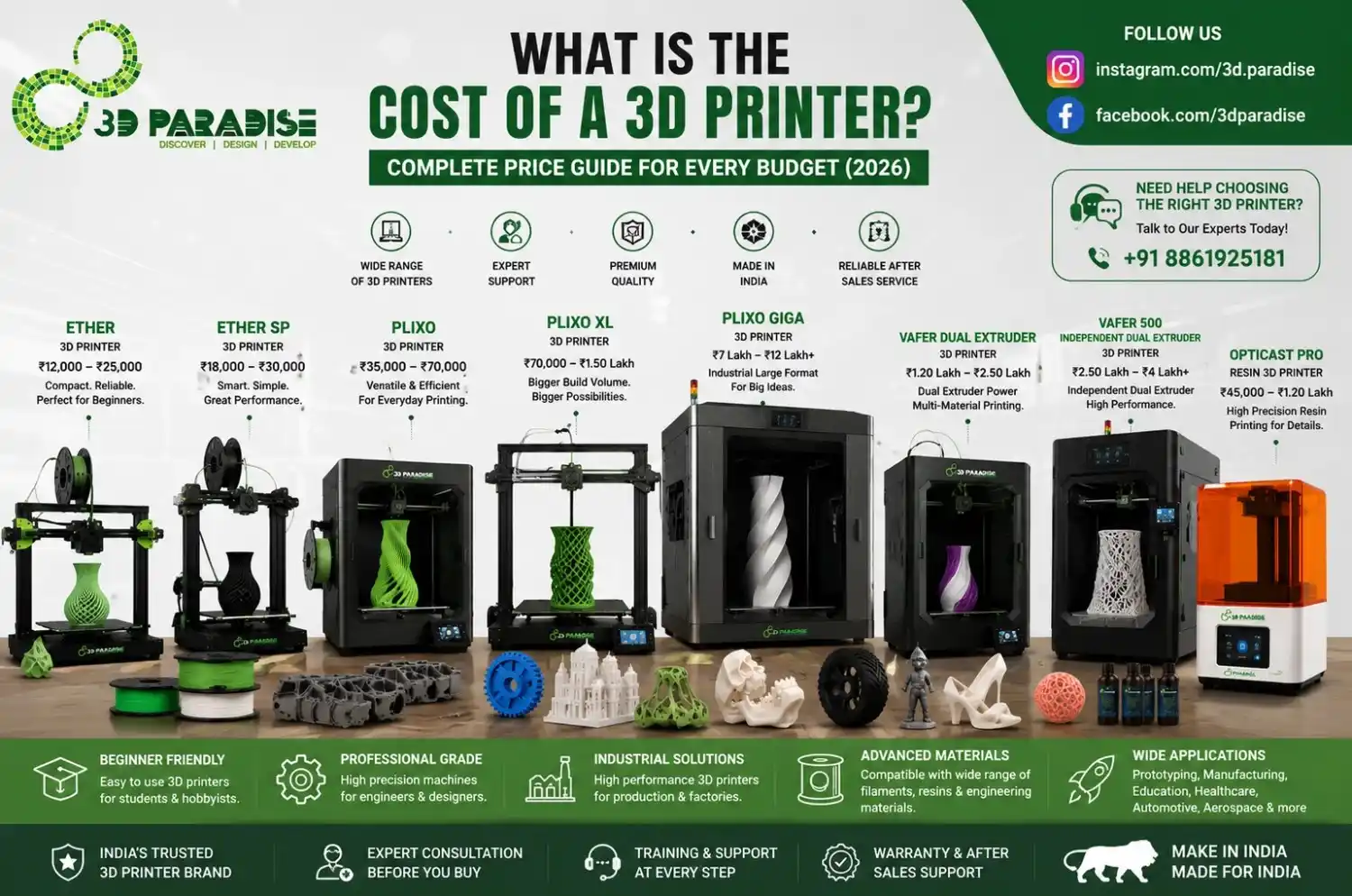
- Ether 3D Printer: A compact single-extruder FDM machine with a 200x200x200mm build volume, an integrated real-time filament dryer, and power-failure resume. A solid entry point for prototyping and small functional parts.
- Ether SP 3D Printer: A refined variant in the Ether lineup, built for users who want reliable single-extrusion printing with the same Make-in-India build quality.
- Plixo 3D Printer: A mid-range FDM printer designed for designers and small studios who need dependable everyday printing without stepping up to industrial pricing.
- Plixo XL 3D Printer: The larger-format version of the Plixo series, suited to bigger prototypes and parts that outgrow standard desktop build volumes.
- Plixo Giga 3D Printer: An industrial large-format printer with a massive 1000x1000x1000mm build volume, 50-micron accuracy, and 24/7 duty-cycle construction. Built for manufacturers, architecture studios, and R&D teams producing large parts in a single print.
- Vafer Dual Extruder 3D Printer: A 300x300x300mm dual-extrusion machine with an inbuilt UPS, air filtration, and support for 20+ materials including ABS, ASA, PETG, and polycarbonate. Ideal for multi-material and support-material printing.
- Vafer 500 Independent Dual Extruder 3D Printer: A larger-format, independent dual-extruder machine for teams that need bigger parts, faster multi-material output, and greater production flexibility.
Resin 3D Printers
- Opticast Pro Resin 3D Printer: Paradise-3D’s resin printing solution, built for high-detail applications like jewellery casting, dental models, and miniatures where surface finish matters more than build volume.
Materials
- 3D Printer Filament: A range of filaments to match whichever machine you choose, so material compatibility and quality are never an afterthought.
All Paradise-3D printers are manufactured in India and come with expert consultation before you buy, so you get a machine matched to your actual print volume and materials rather than one picked off a spec sheet. Pricing is quote-based depending on configuration; you can book a free consultation to get exact numbers for your use case.
Frequently Asked Questions
1. What is the average cost of a 3D printer?
Most desktop 3D printers for personal or small business use cost between ₹15,000 and ₹2 lakh, depending on technology, build volume, and materials supported.
2. How much does a 3D printing machine cost in India?
Prices range from around ₹12,000 for basic FDM printers to over ₹1 crore for industrial metal printers, with most buyers landing between ₹15,000 and ₹5 lakh depending on their needs.
3. Which is the cheapest 3D printer?
Entry-level FDM printers are the cheapest category, with reliable options available starting around ₹12,000–₹15,000.
4. What is the maintenance cost of a 3D printer?
Expect to spend ₹500–₹3,000 periodically on nozzles, belts, and bed surfaces, with occasional larger repairs depending on usage intensity.
5. Is resin printing more expensive than FDM?
Resin material costs more per liter than filament, and resin printing involves additional post-processing steps like washing and curing, making it generally pricier to run than FDM for the same output.
6. Which 3D printer is best for beginners?
An entry-level auto-leveling FDM printer is best for beginners, offering an easier learning curve and lower upfront cost compared to resin or industrial machines.
7. Can businesses save money by owning a 3D printer?
Yes, if print volume is high enough that the cost per part beats outsourcing over time. For occasional or specialized needs, using a 3D printing service is often more cost-effective.
8. How long does a 3D printer last?
With regular maintenance, a well-built desktop 3D printer can last several years and thousands of print hours before major components need replacement.
Final Thoughts
The cost of a 3D printer depends far more on your intended use than any single “average” price. A student needs a very different machine than a manufacturer producing functional parts at scale. Before buying, map your budget against your actual use case, factor in the hidden costs of materials and maintenance, and consider whether owning a printer or outsourcing to a service like Paradise-3D makes better financial sense for your volume.
Whichever path you choose, understanding the full picture of 3D printer cost, not just the sticker price, will help you make a decision you won’t regret six months in.