Cost of 3D Printing in India: Complete Pricing Guide (2026)
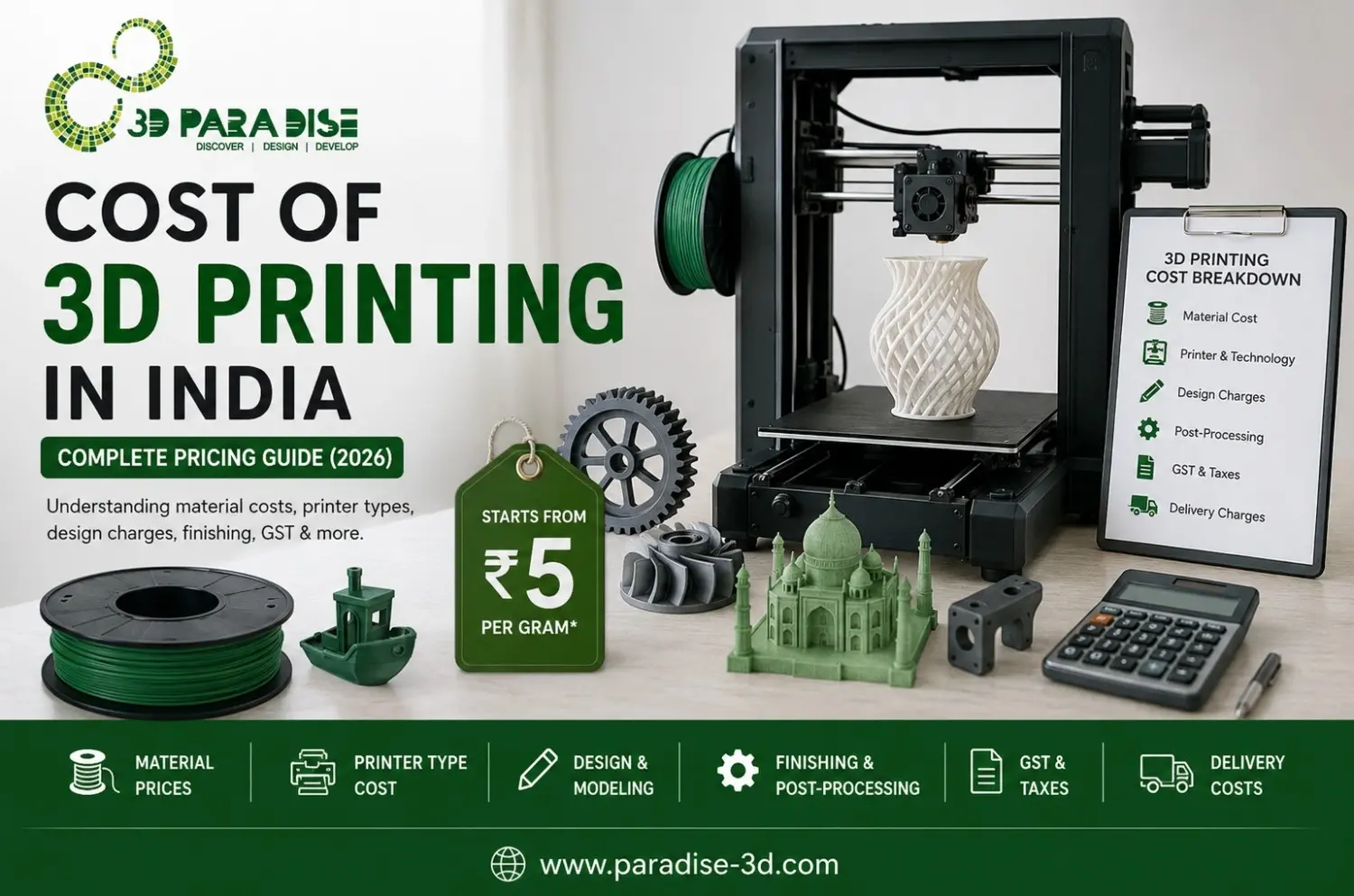
How much does 3D printing cost in India? The answer depends on several factors, including the printing technology, material, part size, design complexity, finishing requirements, and production quantity. In most cases, 3D printing prices in India range from as little as ₹5 for a simple prototype to more than ₹10 lakh for large industrial or metal components.
If you’re planning to create a prototype, manufacture custom parts, or print a product, estimating the cost can be confusing. Material prices, machine selection, design charges, post-processing, GST, and shipping can all affect the final price, making it difficult to know what you’ll actually pay.
This guide breaks down every cost component in simple terms. You’ll learn how 3D printing pricing works in India, compare the costs of different printing technologies and materials, review real pricing examples, and discover practical ways to reduce your overall printing expenses. Whether you’re a student, startup, engineer, designer, or manufacturer, this guide will help you plan your budget with confidence and avoid unexpected costs.
What Decides Your 3D Printing Cost
Your final price comes from several factors working together, not just one:
- Material weight and type
- Printing time
- Printer type and technology
- Design and file preparation work
- Post-processing and finishing
- Order volume (single piece vs. bulk)
- GST and import duty, where applicable
- Delivery distance and urgency
Understanding each factor lets you estimate a fair price before you even request a quote, and it helps you spot when a vendor’s number seems unusually high or unusually low.
Material Pricing Per Gram in India
Material cost is the biggest factor in most 3D printing jobs. You pay more for strength, fine detail, or specialty performance.
| Material | Price per Gram (₹) | Best For |
|---|---|---|
| PLA | ₹5 – ₹15 | Simple models and prototypes |
| ABS | ₹10 – ₹20 | Functional parts and enclosures |
| PETG | ₹10 – ₹20 | Outdoor items and food-safe parts |
| Resin (SLA) | ₹20 – ₹50 | Highly detailed models and miniatures |
| Nylon PA12 | ₹45 – ₹80 | Durable functional parts |
| Carbon Fiber & Metal Powders | ₹100 – ₹500+ | High-strength applications in automotive and aerospace |
Example: A 100-gram PLA print usually lands between ₹1,000 and ₹1,500. The same part in resin often costs ₹2,000 to ₹4,000, since resin machines need finer optics and the print requires additional cleaning and curing steps that PLA does not.
How Much Does PLA 3D Printing Cost in India?
PLA 3D printing costs around ₹5–₹15 per gram in India. A 100-gram PLA print typically costs ₹500–₹1,500, depending on the print size, quality, infill, and finishing.
PLA is the most affordable 3D printing material and is ideal for prototypes, educational models, and functional parts. It prints quickly but usually has visible layer lines.
Best for:
- Prototypes
- Functional testing
- Educational projects
- Low-cost models
How Much Does Resin 3D Printing Cost in India?
Resin 3D printing typically costs ₹20–₹50 per gram in India. A 100-gram resin print usually costs ₹2,000–₹5,000, depending on the resin type, print resolution, and post-processing.
Resin produces smooth, highly detailed parts but costs more because it requires washing and UV curing after printing.
Best for:
- Miniatures
- Jewellery patterns
- Dental models
- High-detail prototypes
Printer Types and Hourly Cost
Printer choice changes both the finish quality and the price you pay. Choose the printer that fits the part’s actual requirement, not the cheapest hourly rate on offer.
| Printer Type | Average Cost per Hour (₹) | Typical Use |
|---|---|---|
| FDM Desktop | ₹200 – ₹500 | Low-cost prototypes and sturdy functional parts |
| SLA or DLP (Resin) | ₹500 – ₹1,500 | Smooth finishes and small, detailed features |
| SLS or MJF | ₹1,500 – ₹4,000 | Small-batch production and functional parts without support structures |
| Metal Printing | ₹5,000 – ₹10,000 | Medical and aerospace-grade parts |
A part that needs to survive mechanical stress or heat is often better suited to SLS nylon than to a cheaper FDM print that may warp or crack under the same load. Paying slightly more upfront for the right technology usually costs less than reprinting a failed part in the wrong material.
Read also: What Is the Cost of a 3D Printer
What Does It Cost to Own a 3D Printer?
Everything above covers what you pay to get something printed as a service. If you are printing regularly, it is worth understanding what owning a machine costs, because that changes the calculation entirely.
- Entry-level desktop FDM printers: ₹12,000 – ₹30,000
- Mid-range and enclosed FDM printers: ₹30,000 – ₹2 lakh
- Resin printers (desktop to professional): ₹15,000 – ₹1.5 lakh
- Industrial SLS printers: ₹7 lakh and above
- Metal 3D printers: ₹25 lakh and above
Owning a printer adds ongoing costs of its own: electricity, spare parts, nozzle and belt replacement, software, and material waste from failed prints. As a practical benchmark, if you need fewer than 10 to 15 prints a month, using a 3D printing service is usually cheaper once you account for these ownership costs. Once your volume regularly exceeds that, owning a printer, especially a basic FDM machine, typically starts paying for itself within a few months.
Design Charges If You Need a Model
If you already have an STL file, you save on this cost entirely. If you do not have one, a designer needs to create a print-ready file for you.
| Complexity | Estimated Price (₹) |
|---|---|
| Simple Objects | ₹500 – ₹1,000 |
| Medium Parts with Logos and Small Features | ₹1,500 – ₹3,000 |
| Complex Mechanical Assemblies | ₹5,000 – ₹10,000 |
Why File Quality Affects Your Design Cost
Most pricing guides stop at “you need an STL file,” but the quality of that file matters just as much as whether you have one. Files with non-manifold edges, inconsistent wall thickness, or missing support geometry usually need repair before they can be printed accurately.
If you are supplying your own file, it is worth running a basic mesh-repair check before sending it to a vendor. Fixing errors after a provider flags them typically adds 20% to 40% on top of the original design quote, since it means reworking the file rather than starting clean.
While STL remains the most common format, some vendors also accept STEP or OBJ files, particularly for parts that started as a CAD model rather than a scan. Ask your provider which formats they accept before finalizing your file, since converting between formats late in the process can introduce its own errors.
Post-Processing and Finishing
Finishing changes both the look and the cost of a print. Consider which finishes your part genuinely needs before adding all of them by default.
| Task | Approx. Price (₹) | When You Actually Need It |
|---|---|---|
| Support Removal | ₹100 – ₹500 | Any print with overhangs; effectively mandatory |
| Sanding & Smoothing | ₹200 – ₹1,500 | Before painting, or for parts that will be handled or displayed |
| Spray Painting | ₹500 – ₹2,000 | Presentation models and branded parts; requires sanding first |
| Resin Curing (UV) | ₹100 – ₹300 | All resin prints; mandatory for the part to reach full strength |
Minimum Order Quantities and Bulk Pricing
For production-volume orders, per-unit pricing usually drops once you cross a vendor’s minimum batch threshold, since setup time and machine calibration get spread across more parts. If you need more than 20 to 50 identical parts, always ask your vendor for volume pricing separately rather than assuming the per-piece rate stays flat. Many providers, including Paradise-3D, offer tiered pricing once a job moves from a one-off prototype to a repeat production run.
Real Cost Examples for 2026
| Item | Specification | Total Cost (₹) |
|---|---|---|
| Custom Name Keychain | PLA, 12 grams, basic file | ₹150 – ₹250 |
| Branded Phone Stand | PLA, 80 grams, minor edits, FDM print, sanded | ₹1,200 – ₹2,000 |
| Gaming Miniature | Resin, 40 grams, SLA print, painted | ₹2,500 – ₹4,500 |
| Industrial Electronics Enclosure | ABS, 120 grams, custom CAD, industrial FDM, polished | ₹5,000 – ₹8,000 |
How to Get an Accurate Quote From a 3D Printing Vendor
A vague request gets a vague quote, and vague quotes lead to price disputes later. Share the following details upfront so a vendor can give you an accurate number the first time:
- Exact material and color required
- Part weight or dimensions, or the file itself
- Required tolerance or fit, if the part needs to assemble with another component
- Finish level needed: as-printed, sanded, or painted
- Quantity: single unit, small batch, or bulk production
This also gives you a fair way to compare quotes across vendors, since two providers quoting the same specifications are far easier to compare than two vague, unstructured estimates.
Lead Times in India
- Prototype: 2 to 5 working days, including design time
- Bulk orders after approval: 7 to 15 days
- Large or complex batches: 20 to 30 days
Lead times can extend during high-demand periods, particularly around festive seasons or when resin demand spikes for detailed work like jewelry casting.
Trends Shaping 3D Printing Cost in India
- Material prices for common filaments like PLA and PETG have remained largely stable through 2025 into 2026, which makes budgeting more predictable for repeat buyers.
- Demand for resin printing has grown steadily, particularly in jewellery casting and dental applications, which has occasionally lengthened lead times during peak months.
- Nylon PA12 and MJF technology have gained wider adoption for low-volume manufacturing, as businesses look for functional-part durability without the cost of metal printing.
- Metal 3D printing remains a premium category, largely due to powder handling requirements, machine maintenance, and the specialized expertise needed to operate these systems safely.
Practical Tips to Reduce Your 3D Printing Cost
A few small decisions before you order can meaningfully lower your final bill without compromising quality.
- Reduce surface area, not just volume. Hollowing out a model or adding internal lattice structures where strength allows can cut material use significantly, since printers charge largely by weight and time, not by the visual size of the part.
- Orient the part efficiently. The way a model is oriented on the print bed affects how much support material it needs. A well-oriented part often needs less support removal and sanding, which lowers post-processing cost.
- Batch similar parts together. If you need several small items, printing them in a single job reduces setup time compared to ordering them separately.
- Match the material to the actual use case. Choosing PLA for a prototype that only needs to look right, instead of defaulting to resin or nylon, is one of the simplest ways to avoid overspending.
- Ask for a design review before printing. A quick check for wall thickness and support requirements before the print starts costs far less than reprinting a failed part afterward.
These adjustments come from practical, everyday production experience rather than theoretical advice, and they typically make the biggest difference for buyers ordering multiple parts or repeat batches.
What to Look for When Choosing a 3D Printing Vendor
Price is only one part of the decision. A slightly higher quote from a reliable vendor often costs less overall than a cheaper one that requires reprints or misses deadlines.
- Technology range: Does the vendor offer FDM, resin, and SLS, or will you need multiple vendors for different materials?
- Turnaround transparency: Do they give you a clear lead time upfront, including for design and post-processing steps?
- Quality control: Do they inspect parts before dispatch, particularly for functional or industrial-use components?
- Communication before printing: Do they flag file issues or ambiguous specifications before starting the print, or only after?
- After-sales support: If a part doesn’t meet the agreed specification, is there a clear process for reprinting or resolving the issue?
Providers like Paradise-3D build these checks into the ordering process specifically because file errors and material mismatches are two of the most common reasons a first print doesn’t meet expectations.
Common Mistakes Buyers Make When Estimating 3D Printing Cost
- Assuming price is only about material weight. Machine time, design work, and finishing often add up to more than the raw material cost itself.
- Ignoring GST until the final invoice. Always ask whether a quote is tax-inclusive before comparing vendors.
- Choosing resin for parts that do not need it. Many buyers overspend on resin printing where a well-finished FDM part would have done the job at a fraction of the cost.
- Not checking file quality before submission. A file with errors almost always costs more to fix after the fact than it would have taken to clean up beforehand.
- Overlooking bulk pricing. Buyers ordering multiple units frequently forget to ask for volume discounts, paying the single-piece rate unnecessarily.
Frequently Asked Questions
1. How do 3D printing companies calculate cost in India?
They calculate cost based on material weight, printing time, and post-processing work, and add design charges if a print-ready file needs to be created. GST at 18% applies on top of the service cost.
2. Is 3D printing cheaper than CNC machining?
For prototypes and complex shapes, 3D printing usually costs less. For high-precision metal parts produced at scale, CNC machining can become more cost-effective per unit.
3. Do colors change the price?
No, unless you choose specialty or multi-material colors. Standard color choices do not add to the cost.
4. How long does a typical print take?
Small prints usually finish in one to three hours. Larger or more detailed prints can take ten hours or more, depending on size and layer resolution.
5. Can I print flexible parts?
Yes, flexible parts can be printed using TPU or TPE material, which behaves similarly to standard filament but produces a soft, rubber-like finished part.
6. Do I need to prepare the 3D model before printing?
Yes, you need a print-ready file, most commonly in STL format. If you do not have one, a provider like Paradise-3D can assign a designer to prepare it for you based on your requirements or reference images.
7. Does GST apply to 3D printing services and printers?
Yes. 3D printing services are taxed at 18% GST under SAC code 9989, and 3D printers are taxed at 18% GST under HSN code 8477.
8. Is it cheaper to buy a 3D printer or use a printing service?
It depends on your volume. Occasional buyers usually save money using a service, while those printing more than 15 to 20 parts a month often find that owning a printer pays for itself within months.
9. What information should I share to get an accurate quote?
Share the material, color, weight or dimensions, required tolerance, finish level, and quantity. This lets a vendor quote accurately the first time and makes it easier to compare quotes across providers.
10 How do minimum order quantities affect pricing?
Per-unit cost typically drops once an order crosses a vendor’s bulk threshold, since setup and machine time get distributed across more parts. Always request volume pricing separately for orders above 20 to 50 units.
Final Thoughts
The cost of 3D printing in India depends on far more than material weight alone. Machine technology, design work, finishing, taxes, and order volume all shape your final price, and understanding each factor helps you request accurate quotes and avoid overpaying. Whether you print occasionally through a service or are considering owning a machine for regular work, comparing your actual volume against ownership costs is the clearest way to make the right decision. Paradise-3D offers consultation for both paths, helping you choose the option that fits your budget and production needs before you commit.