How Is Digital Manufacturing Transforming the Future of the Automotive Industry?
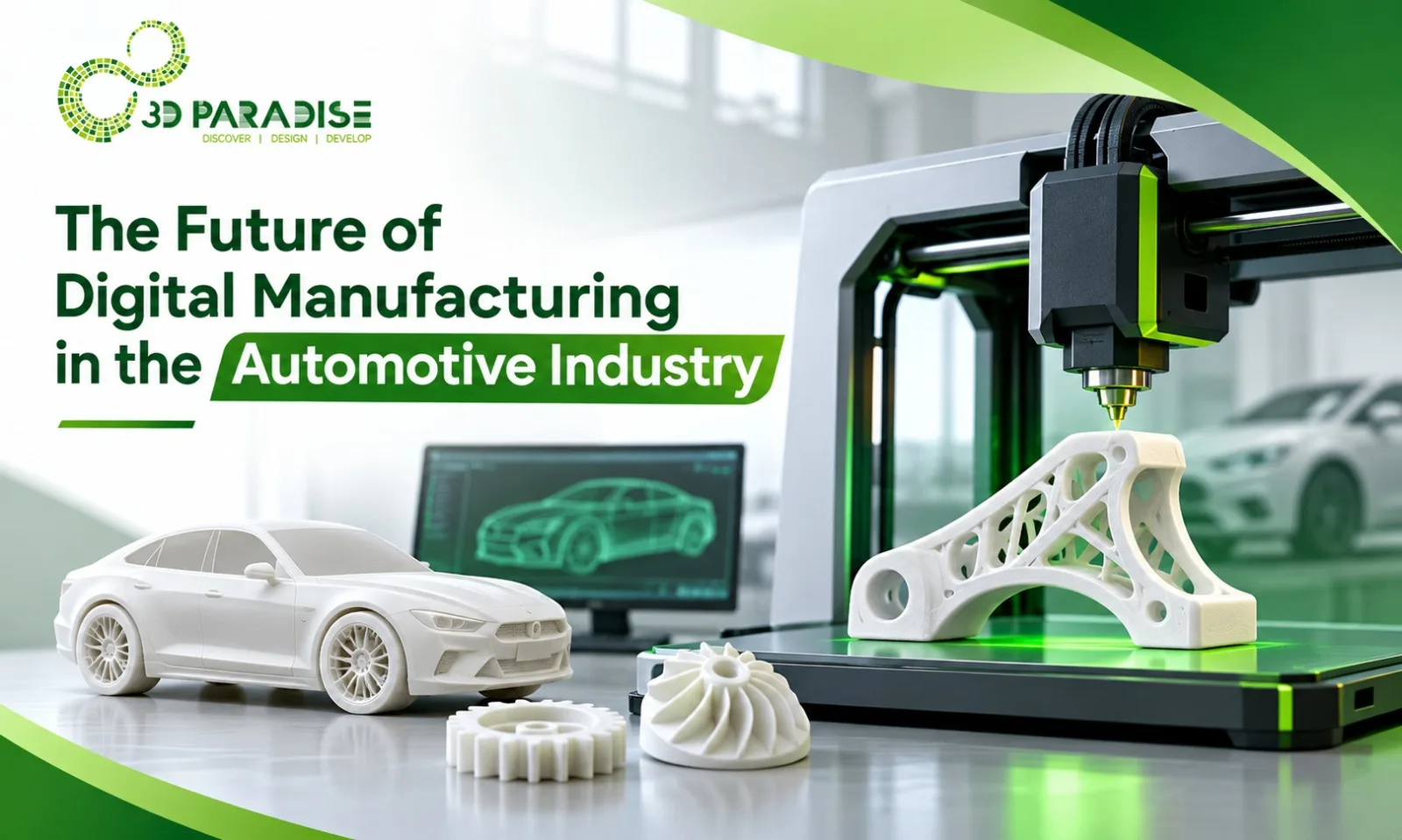
Digital manufacturing is changing how automotive companies design, test, and produce vehicle components. Technologies such as 3D printing, computer-aided design (CAD), automation, and digital simulation help manufacturers develop prototypes faster, improve production flexibility, and reduce dependence on expensive tooling.
India is also seeing rapid growth in additive manufacturing. According to MarketsandMarkets, the Indian 3D printing market is projected to grow from USD 276.2 million in 2025 to USD 762.6 million by 2030, at a compound annual growth rate (CAGR) of 22.5%.
For automotive manufacturers, Next-Generation Automotive 3D Printing Technology creates new opportunities in rapid prototyping, custom component development, and low-volume production. 3D Paradise supports these applications through automotive 3D printing services that help businesses turn digital designs into physical components.
What Is Digital Manufacturing in the Automotive Industry?
Digital manufacturing means using computer-based technologies to plan, develop, and manufacture automotive components.
Instead of relying entirely on physical models and conventional production methods, engineers can create digital designs, test them virtually, and manufacture suitable parts with greater flexibility.
The main technologies include:
- 3D printing: Produces physical components directly from digital models.
- CAD software: Helps engineers design and modify automotive parts.
- Digital simulation: Evaluates designs before physical production.
- Automation and robotics: Support accurate and repeatable manufacturing operations.
- Computer-aided manufacturing: Connects digital designs with production equipment.
Among these technologies, additive manufacturing in the automotive industry is particularly useful for prototyping, customized parts, and production tooling.
How Is Digital Manufacturing Growing in India’s Automotive Industry?
India’s automotive sector is a major part of the country’s manufacturing economy. According to ACMA and NITI Aayog, the automotive industry accounts for approximately 49% of India’s manufacturing GDP.
The expansion of additive manufacturing is creating opportunities for automotive component manufacturers, suppliers, and engineering businesses.
Key Indian Manufacturing Statistics
| Indicator | Reported data | Source |
| India’s 3D printing market | USD 276.2 million in 2025 | Markets and Markets |
| Projected 3D printing market | USD 762.6 million by 2030 | Markets and Markets |
| Annual market growth | 22.5% CAGR, 2025–2030 | Markets and Markets |
| Broader additive manufacturing forecast | USD 1.4 billion by 2031 | Research and Markets |
| Metal additive manufacturing market | USD 290.10 million in 2026, projected to reach USD 572.46 million by 2031 | Mordor Intelligence |
These estimates come from separate market research reports with different market definitions and forecasting methods. They should not be treated as one continuous forecast.
Government Support for Additive Manufacturing
India’s Ministry of Electronics and Information Technology (MeitY) introduced the National Strategy for Additive Manufacturing (NSAM) in February 2022.
Its original objectives included capturing 5% of the global additive manufacturing market and contributing nearly USD 1 billion to India’s GDP.
With NSAM 2.0 being prepared in 2026, the government is continuing to encourage domestic manufacturing capabilities, technology development, and industry adoption.
Source: MeitY / Press Information Bureau, October 2026.
How Is 3D Printing Changing Automotive Manufacturing?
1. Reducing Automotive Prototyping Time
Automotive engineers often need several physical samples before approving a component for manufacturing.
3D printing allows them to produce prototypes directly from CAD files, test dimensions and fit, identify problems, and modify designs without creating new molds for every version.
Indian automotive example:
A TVS Group automotive seating company used industrial 3D printing to improve its prototype development process.
| Measurement | Traditional method | 3D printing |
| Prototype development time | 8 days | 2 days |
| Development cost | ₹5,600 | ₹1,800 |
| Time reduction | — | 75% |
| Cost reduction | — | Approximately 68% |
The example demonstrates how additive manufacturing can improve development efficiency when the application is suitable.
Source: Divide By Zero Technologies, automotive seating case study.
2. Reducing Tooling and Development Expenses
Traditional automotive manufacturing may require expensive molds, dies, or machining setups.
3D printing can reduce these initial expenses, particularly when manufacturers need prototypes, specialized tools, or limited quantities.
A reported example from Chennai’s Sriperumbudur industrial area illustrates the potential benefits:
- More than 220 SMEs reportedly adopted in-house 3D printing between 2022 and 2024.
- Average prototyping cycle time reportedly decreased by 55%.
- Prototype outsourcing costs reportedly declined by 48%.
These are reported results from a particular industrial cluster, not guaranteed savings for every manufacturer.
Source: Economic Times, citing TechSci Research, 2025.
3. Manufacturing Custom Automotive Parts
Automotive businesses frequently need components that are difficult or expensive to produce through conventional methods.
Examples include dashboard prototypes, custom brackets, protective housings, positioning tools, and specialized fittings.
3D Paradise provides automotive 3D printing services for prototypes, customized components, and suitable manufacturing-support applications.
This can help automotive businesses evaluate new designs before committing to larger production investments.
4. Supporting Lightweight Component Design
Vehicle weight affects energy consumption and overall performance.
With digital design software and additive manufacturing, engineers can explore complex shapes, internal structures, and designs that use less material.
This is particularly relevant to electric vehicle development, where component weight, packaging, and efficiency are important considerations.
However, lightweight printed components must still meet the required strength, durability, and safety standards.
Is 3D Printing Cheaper Than Traditional Automotive Manufacturing?
3D printing can be more economical for prototypes and certain low-volume batches because it avoids dedicated mould costs. Injection moulding may become more economical as production quantities increase.
The decision depends on the material, component size, manufacturing process, and order quantity.
| Factor | 3D printing | Injection molding |
| Initial tooling cost | Usually low | Often high |
| Prototype development | Suitable for repeated design changes | May require tooling modifications |
| Small production batches | Often economical | Tooling cost may be difficult to justify |
| Large production volumes | Higher unit costs may limit suitability. | Often lower cost per unit |
| Design changes | Usually easier through digital file updates | May require mold changes |
For example, one published Indian automotive cost comparison estimated ₹82 per clip using SLS versus ₹117 using FDM for a batch of 100 interior clips, including relevant processing costs.
This is a specific reported comparison, not a standard price for automotive components.
There is also no fixed rule that injection molding becomes cheaper after 300 units. The break-even quantity must be calculated for each project.
Sources: Autoabode, 2026; Formlabs manufacturing cost analysis.
Which Materials Are Suitable for 3D Printed Automotive Parts?
Automotive components may face heat, vibration, pressure, and repeated mechanical stress. Choosing the appropriate printing material is therefore important.
| Material | Common automotive applications | Important consideration |
| ABS | Dashboard prototypes, interior housings | Grade-specific heat and impact resistance |
| PETG | Fitting prototypes, non-critical brackets | Limited suitability for high-temperature use |
| Nylon / PA12 | Clips, housings, functional prototypes | Mechanical and thermal properties depend on process and grade. |
| Engineering composites | Lightweight tooling and selected components | Strength and temperature performance require validation. |
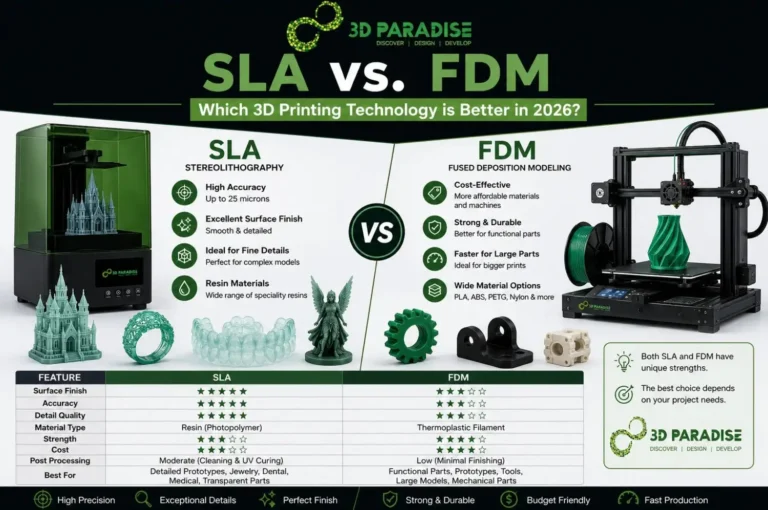
| SLA resins | Detailed models and precision prototypes | Functional suitability depends on resin properties. |
For example, some engineering-grade nylons offer greater heat resistance than standard PETG. However, material performance must be checked against the manufacturer’s technical data sheet, including heat-deflection temperature and continuous-use conditions.
Under-hood components and safety-critical automotive parts require additional engineering testing.
Source: Formlabs, 3D Printing Material Selection Guide.
What Is the Future of Digital Manufacturing in the Automotive Sector?
The future of digital automotive manufacturing is likely to involve greater use of connected design tools, automation, simulation, and additive manufacturing. These technologies will be particularly useful for prototyping, tooling and customized components.
Three developments are especially relevant.
Faster product development: Automotive manufacturers can use digital models and rapid prototypes to test design changes earlier.
Flexible component production: 3D printing allows suitable custom parts and small batches to be manufactured without developing dedicated moulds for every design.
Advanced manufacturing for electric vehicles: New vehicle designs create opportunities for lightweight parts, custom tooling, prototype battery-system housings, and specialized components.
India’s expanding additive manufacturing market and government support may encourage more automotive suppliers to evaluate these technologies.
However, 3D printing will continue to work alongside traditional manufacturing rather than replacing every production method.
How Is 3D Paradise Supporting Digital Automotive Manufacturing?
As automotive manufacturing becomes more digitally connected, companies need practical ways to turn designs into testable physical components.
3D Paradise supports this requirement through its automotive 3D printing and rapid prototyping services in India.
Its publicly described service applications include:
- Automotive prototypes for design and fit evaluation
- Customised components for specific project requirements
- Jigs, fixtures and manufacturing-support tools
- Low-volume automotive part production
- Additive manufacturing support for product development
These services can help manufacturers assess new designs and select appropriate production methods.
For automotive companies developing a new component, the main benefit is the opportunity to evaluate a physical design before investing in full-scale manufacturing.
3D Printing for Architects in India
3D printing is also changing how architects and construction professionals develop and present their designs in India. Similar to automotive manufacturing, it allows designers to convert digital models into accurate physical prototypes before final production or construction.
With 3D printing in architecture, professionals can create detailed architectural scale models, conceptual prototypes, customised design elements and complex structures that may be difficult to reproduce using traditional modelling techniques.
3D Paradise supports architects and designers through 3D printing solutions for architectural models, detailed prototypes and customised design components. These services help professionals evaluate designs, communicate project concepts and make necessary changes before moving forward.
Frequently Asked Questions
1. How is digital manufacturing transforming the automotive industry?
Digital manufacturing helps automotive companies design, test, and produce components using CAD, simulation, automation, and 3D printing. It improves design flexibility and can reduce development time and tooling expenses for suitable applications.
2. What is the future of 3D printing in India’s automotive industry?
3D printing is expected to play a growing role in automotive prototypes, customised parts, manufacturing fixtures and selected production components. India’s expanding additive manufacturing market and government initiatives may support wider adoption.
3. How much can automotive manufacturers save through 3D printing?
Savings depend on the component and manufacturing process. In one Indian automotive seating case, 3D printing reduced prototype development time by 75% and costs by approximately 68%. These results are specific to that project.
4. Can 3D printing replace traditional automotive manufacturing?
Not completely. 3D printing is particularly useful for prototypes, complex designs and selected low-volume production. Traditional manufacturing remains important for large quantities and applications requiring specific production methods.
5. Is 3D printing suitable for functional automotive parts?
Yes, provided the chosen material, printing process, and finished component meet the relevant performance requirements. Heat exposure, mechanical loads, vibration, and safety requirements must be considered.
Conclusion
As shown in the data, 3D printing is becoming a key part of digital manufacturing. Digital manufacturing is reshaping automotive product development through faster prototyping, flexible component design and more efficient manufacturing processes.
India’s growing additive manufacturing market, supported by government initiatives and industrial adoption, creates opportunities for automotive manufacturers to explore these technologies.
For businesses considering 3D printing in automotive manufacturing, 3D Paradise offers support for rapid prototyping, customised parts and manufacturing-support applications.
Planning a new automotive component or prototype? Explore automotive 3D printing services to discuss your design requirements, suitable materials, and production options.