What Is SLA 3D Printing? How the Stereolithography Process Works, Materials Used, Cost and Real Applications in India
If you have ever held a 3D-printed part and noticed how smooth and accurate it feels, almost like injection molding, there is a very good chance it was produced using SLA 3D printing, also known as the stereolithography process. Stereolithography (SLA) is widely recognized as one of the most precise resin 3D printing technologies available today, capable of producing extremely fine details, smooth surface finishes, and consistent dimensional accuracy. Across India, it is rapidly becoming the preferred technology for engineers, product designers, dental laboratories, jewelry manufacturers, and industrial teams that require reliable, production-quality results.
At 3D Paradise, a Delhi-based ISO-certified 3D printing service provider, we have been delivering professional SLA and resin 3D printing services in India for years across industries ranging from healthcare and manufacturing to product development and research. In this guide, we explain how the stereolithography process works, how it compares with technologies like FDM and SLS, which materials are best suited for different applications, what typical SLA 3D printing costs look like in India, and how you can confidently order your first SLA print with the right specifications.
What You Will Learn in This Guide
In this complete guide to SLA 3D printing and the stereolithography process, you will understand how resin-based additive manufacturing works in real production environments across India. Whether you are developing prototypes, manufacturing precision components, or evaluating different 3D printing technologies, the following sections will help you make informed decisions with confidence.
- What is SLA 3D printing and how the stereolithography process works step by step
- SLA vs FDM vs SLS comparison – which 3D printing technology is right for your project requirements
- Materials available for SLA and resin 3D printing in India, including engineering, dental, and castable resins
- Key industries and real-world applications of stereolithography across manufacturing, healthcare, and product development
- SLA 3D printing cost in India – factors that influence pricing and how to estimate project budgets
- Complete workflow of SLA 3D printing, from CAD design and file preparation to final part delivery
- Post-processing methods for SLA parts, including sanding, painting, curing, and surface finishing
- How to order professional SLA 3D printing services in India from 3D Paradise with the right material and specifications
1. What Is SLA 3D Printing?
Stereolithography (SLA) – also known as vat photopolymerisation or resin 3D printing — is an advanced additive manufacturing technology in which a controlled light source selectively cures liquid photopolymer resin into solid three-dimensional objects, building each component one thin layer at a time through the stereolithography process. This method is widely used in engineering, dental, medical, and product development environments where precision and surface quality are critical.
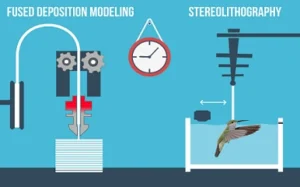
Unlike FDM (Fused Deposition Modelling), which melts thermoplastic filament and deposits material layer by layer, SLA 3D printing uses ultraviolet light to chemically transform liquid resin into a hardened, fully formed solid. This light-driven curing process is responsible for the defining advantages of stereolithography, including extremely fine feature resolution, smooth surface finishes, and dimensional accuracy that can approach CNC machining standards for small-to-medium precision parts.
A Short History of SLA
Stereolithography (SLA) is widely recognized as the original 3D printing technology and the foundation of modern additive manufacturing. Japanese researcher Dr. Hideo Kodama first developed the early concept of the stereolithography process in the early 1980s, demonstrating how ultraviolet light could be used to cure liquid photopolymer resin into solid objects. A few years later, American engineer Chuck Hull refined the method, patented the SLA process in 1986, and founded the company 3D Systems, introducing the world’s first commercially available stereolithography system.
For many years, industrial SLA machines were expensive, often costing upward of ₹70–80 lakhs and requiring specialized operators and controlled environments. Today, advances in resin materials, software automation, and compact hardware design have made professional SLA 3D printing significantly more accessible. Modern desktop and industrial stereolithography systems now deliver the same high-resolution results at a fraction of the historical cost, enabling service providers such as 3D Paradise to offer reliable resin 3D printing solutions to businesses, startups, and research institutions across India.
How the Stereolithography Process Works — Step by Step
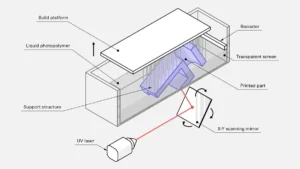
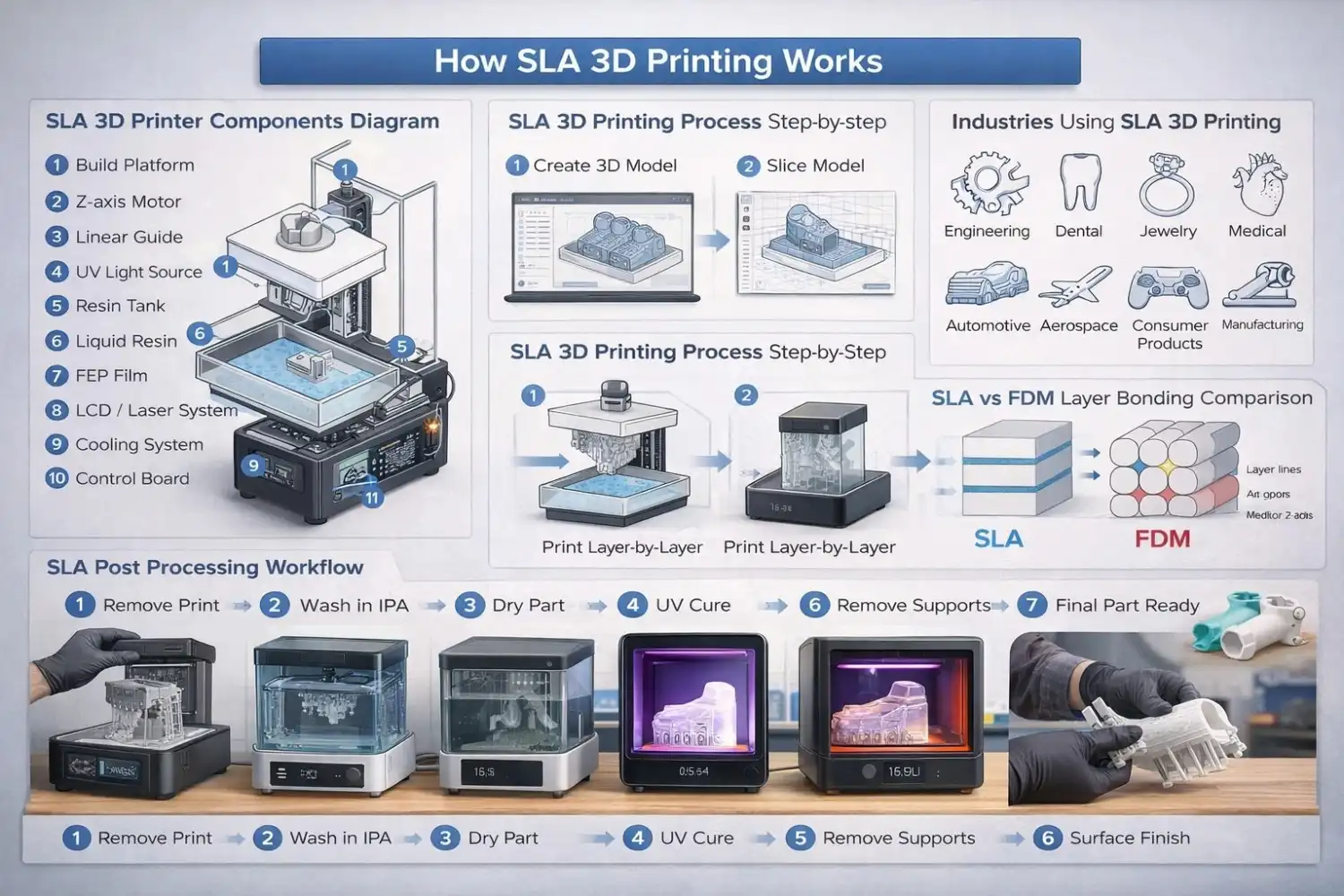
The stereolithography process used in SLA 3D printing is precise, repeatable, and highly controlled. It relies on light-driven curing of liquid resin to produce accurate components for engineering, dental, medical, and manufacturing applications. While the technology appears complex, the core workflow is straightforward and follows a predictable sequence of steps.
- A build platform is lowered into a vat of liquid photopolymer resin, positioning the surface at the correct starting height for the first layer of the print.
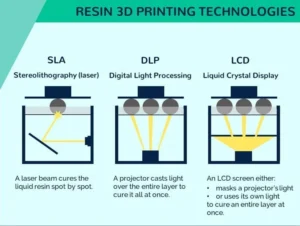
- A UV laser or digital light source traces the cross-section of each layer onto the resin surface. In modern MSLA and DLP systems, a masked LCD or projector exposes the entire layer simultaneously for faster production.
- When ultraviolet light strikes the resin, a chemical reaction called “photopolymerization” occurs, transforming the liquid material into a solid structure with precise geometry.
- The build platform then moves vertically by one layer thickness, typically between 25 and 100 microns, allowing the next layer of the stereolithography build to form directly on top of the previous one.
- After printing is complete, the part undergoes cleaning and post-curing, where it is washed in isopropyl alcohol (IPA) to remove uncured resin and then exposed to controlled UV light to achieve full mechanical strength and dimensional stability.
Key Fact: Precision Capability of SLA Printing
Professional SLA 3D printing systems can produce feature sizes as small as 0.1 mm, which is finer than the diameter of a human hair. This exceptional resolution is one of the primary reasons the stereolithography process is widely used in industries where dimensional accuracy and surface finish are critical. Common high-precision applications include dental models, jewelry casting masters, medical prototypes, micro-mechanical components, and detailed engineering assemblies that require consistent repeatability.
Types of Resin 3D Printing: SLA vs DLP vs MSLA (LCD)
The terms SLA, DLP, and MSLA are often used interchangeably in the 3D printing industry, but they represent three distinct light-source technologies within the broader category of resin 3D printing and stereolithography-based manufacturing. Understanding the differences between these technologies helps engineers, designers, and production teams select the most suitable printing method based on required accuracy, speed, and production volume.
| Technology | Light Source | How It Cures | Best For |
|---|---|---|---|
| SLA (Laser) | UV laser point | Traces layer point by point | Highest accuracy, large parts |
| DLP (Digital Light Processing) | Projector / DMD chip | Flashes entire layer at once | Speed + detail balance |
| MSLA / LCD | Masked LCD + UV backlight | Exposes full layer through mask | Affordable, detailed, fast |
2. SLA vs FDM vs SLS: Which Technology Should You Choose?
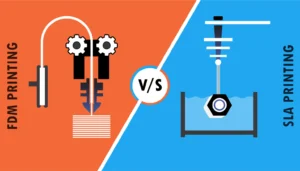
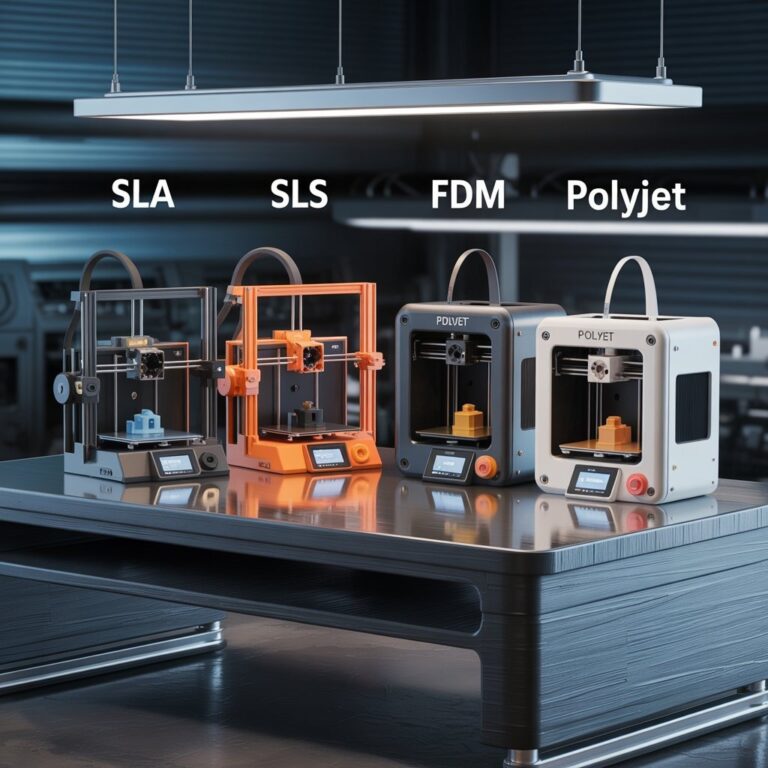
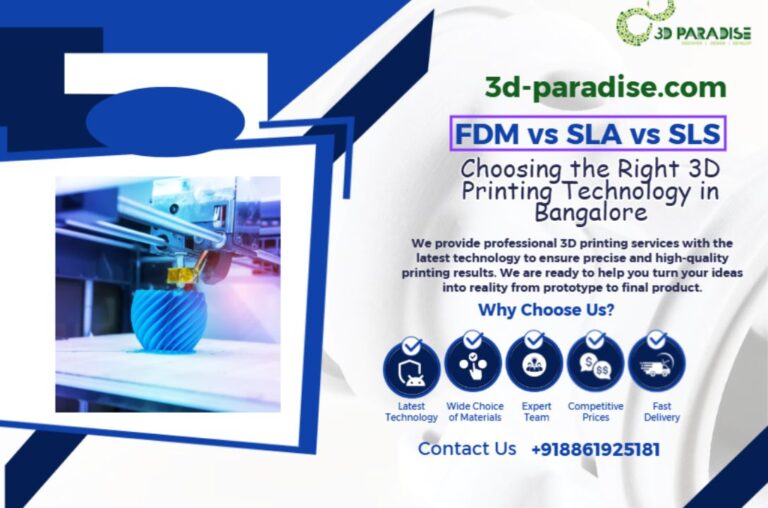
Choosing the right 3D printing technology is one of the most important decisions engineers, manufacturers, and product designers make during prototyping or production. Each additive manufacturing method has a distinct performance profile, cost structure, and material capability. Understanding the differences between SLA (stereolithography), FDM (fused deposition modeling), and SLS (selective laser sintering) helps businesses across Indian industries select the most efficient process based on accuracy, strength, surface quality, and production requirements.
Below is a practical comparison of the three most widely used 3D printing technologies, based on the criteria that matter most in real manufacturing and product development environments.
| Criteria | SLA / Resin | FDM (Filament) | SLS (Powder) |
|---|---|---|---|
| Surface Finish | Excellent — near injection-moulded | Visible layer lines | Slightly grainy texture |
| Dimensional Accuracy | Very high (±0.1–0.2 mm) | Moderate (±0.3–0.5 mm) | High (±0.2–0.3 mm) |
| Feature Detail | Finest — 0.1 mm possible | Limited by nozzle diameter | Good for powder size |
| Material Range | Rigid, flexible, clear, rubber-like, castable, dental, medical | PLA, ABS, PETG, TPU, Nylon | Nylon, TPU, glass-filled |
| Part Strength | Good to excellent (isotropic) | Anisotropic — weak in Z | Excellent — fully isotropic |
| Watertightness | Yes—naturally watertight | Often porous | Yes |
| Cost per Part (India) | Medium — ₹150 to ₹2,500+ | Low — ₹50 to ₹800 | High — ₹500 to ₹5,000+ |
| Best Applications | Prototypes, dental, jewelry, medical, tooling | Concept models, jigs, enclosures | Functional parts, batch production |
When to Choose Each Technology
Choose SLA 3D printing when surface finish, fine detail, or specialized material properties such as transparency, flexibility, or castability are critical to product performance or presentation quality. Choose FDM printing when speed and cost efficiency are the primary priorities and cosmetic finish is less important. Choose SLS printing when producing strong, functional components in moderate volumes without support structures or when consistent mechanical strength is required across all directions.
When SLA Wins Over FDM — Real Examples
- Dental models: FDM cannot achieve the ±0.1 mm accuracy required for clear aligner or crown models. SLA can.
- Jewelry masters: Castable SLA resin burns out cleanly for investment casting. FDM filament does not.
- Clear parts: Only SLA can produce transparent or translucent parts suitable for optical assemblies, lights, or show models.
- Watertight enclosures: SLA parts are intrinsically solid — no layer porosity that lets air or fluid pass through.
- Consumer product prototypes: SLA parts can go straight into customer presentations with no post-processing—FDM parts almost always need sanding.
3. SLA Resin Materials Available in India
One of SLA’s greatest advantages over FDM is the breadth and specialisation of resin materials. At 3D Paradise, we work with a curated selection of professional resins suited to the most demanding applications across Indian industry:
Standard / General Purpose Resins
| Resin Type | Key Properties | Typical Applications |
|---|---|---|
| Grey / White / Black Resin | Smooth, matte finish; high resolution | Concept models, design reviews, jigs, masking tools |
| Clear / Transparent Resin | High transparency; polishable to near-optical clarity | Fluid systems, light guides, show models, molds |
| Fast Model Resin | Rapid printing speed without sacrificing detail | Quick-turn prototypes, iterative design cycles |
Engineering Resins
| Resin Type | Key Properties | Typical Applications |
|---|---|---|
| Tough / ABS-Like Resin | Impact resistant; handles compression and bending | Enclosures, connectors, wear-test prototypes |
| Rigid / Glass-Filled Resin | Stiff, dimensionally stable under load; heat resistant | Jigs, fixtures, turbine models, automotive housings |
| Flexible / Rubber-Like Resin | Bends and compresses without tearing | Gaskets, grips, anatomical models, soft robotics |
| High Temperature Resin | Withstands 200°C+; minimal deflection under heat | Molds, heat shields, automotive testing fixtures |
| ESD-Safe Resin | Dissipates static electricity | Electronics jigs, PCB handling trays, anti-static fixtures |
Castable Resins
| Resin Type | Key Properties | Typical Applications |
|---|---|---|
| Castable Wax Resin | Clean burn-out; zero ash; sharp detail retention | Jewelry investment casting, metal part masters |
| Clear Cast Resin | Low thermal expansion; highly accurate | Industrial investment casting patterns for end-use metal parts |
Dental & Medical Resins
| Resin Type | Key Properties | Typical Applications |
|---|---|---|
| Dental Model Resin | High accuracy (>99% surface within 100 μm of CAD) | Crown/bridge models, orthodontic models, implant analogs |
| Surgical Guide Resin | Autoclavable; biocompatible | Implant placement guides, drill guides, templates |
| Splint / Night Guard Resin | Long-term biocompatible; polishable | Occlusal splints, night guards, retainer bases |
| Biocompatible Resin | ISO 10993-tested; sterilisable | Medical devices, surgical instruments, anatomical planning models |
| 3D Paradise Tip | Not sure which resin suits your project? Call us at +91 8861925181 or WhatsApp us. Our engineers will review your CAD file and recommend the right material — free of charge. |
4. Applications of ( Stereolithography ) SLA 3D Printing
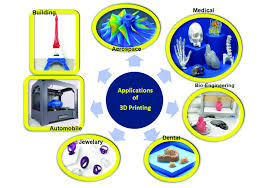
SLA 3D printing is widely used across manufacturing and design-intensive industries in India where precision, speed, and surface quality are essential. The stereolithography process is commonly applied in rapid prototyping, medical modeling, and product development workflows because it consistently produces highly accurate components with smooth finishes and reliable dimensional stability. Below are the primary industries served by 3D Paradise and the practical applications where SLA technology delivers measurable results.
Engineering and Product Design
Rapid prototyping is a critical part of modern product development. SLA 3D printing enables engineers and product designers to move from a CAD model to a physical prototype in as little as 24 hours, often at a significantly lower cost than CNC machining or injection molding tooling. This capability allows teams to evaluate designs quickly, identify issues early, and refine products before committing to production.
Common engineering and product design applications include:
- Concept models for investor presentations and product demonstrations
- Functional prototypes for fit, form, and performance testing
- Validation components before investing in production tooling
- Rapid design iteration, allowing teams to test 3–5 design versions within a single development cycle
Key Insight:
Engineering teams frequently use stereolithography during early product development stages to verify dimensions, ergonomics, and assembly compatibility before transitioning to full-scale manufacturing.
Dental Laboratories and Clinics
Digital dentistry is one of the fastest-growing segments of the 3D printing industry in India, driven by increasing demand for clear aligners, implants, and customized dental devices. SLA resin printing has become the preferred technology for dental model production because it combines high dimensional accuracy, biocompatible materials, and reliable production speed required in clinical environments.
Typical dental applications of stereolithography include:
- Clear aligner thermoforming models produced with consistent dimensional precision
- Crown and bridge working models used in restorative dentistry
- Surgical implant placement guides for accurate treatment planning\
- Hard and soft occlusal splints and night guard appliances
- Full-arch denture bases and patient-specific try-in models
Key Fact:
Professional dental laboratories rely on SLA printing because it consistently achieves dimensional tolerances of approximately ±0.1 mm, which is essential for predictable clinical outcomes and patient comfort
| Opportunity for Dental Labs | 3D Paradise’s OptiCast Pro 4K DLP printer delivers dental-grade accuracy at service bureau pricing. No capital investment required – just upload your STL file and receive biocompatible-certified printed models at your lab. |
Jewelry Design and Manufacturing
SLA 3D printing is widely recognized as the gold standard for 3d printing jewelry production, enabling the creation of intricate settings, prongs, shanks, and fine filigree details that would take a skilled wax carver many hours to produce manually but can be generated quickly and accurately using the stereolithography process.
- Investment casting masters in castable wax resin that burn out cleanly with minimal residue
- Try-on pieces and fit rings used for customer design approval and sizing validation
- Master patterns for rubber mold production and repeatable casting workflows
- High-detail custom jewelry prototypes with precise surface finish and dimensional accuracy
3D Printing in Automotive
3D Printing in automotive sector, including OEM manufacturers, component suppliers, and electric vehicle startups, uses SLA printing extensively throughout the product development and testing lifecycle due to its speed, precision, and design flexibility.
- Aerodynamic wind tunnel test models for performance evaluation and validation
- Interior trim concept prototypes for design and ergonomics assessment
- Custom jigs and assembly fixtures for manufacturing and production support
- End-use, low-volume aftermarket components for specialized vehicle applications
- Sensor housings and mounting bracket prototypes requiring accurate fit and alignment
3D Printing in Medical and Healthcare
From surgical planning to patient-specific medical devices, SLA technology provides the accuracy and biocompatible material compatibility required in modern 3d printing healthcare environments where precision and reliability are essential.
- Anatomical models used for surgical planning, visualization, and clinical training
- Custom orthotics and prosthetic sockets designed for individual patient fit
- Patient-specific implant sizing models for pre-operative assessment
- Medical device prototypes and functional testing components for product validation
3D Printing in Aerospace and Defence
India’s expanding aerospace and defense sector requires components with exceptional dimensional accuracy and consistent performance. Stereolithography printing is commonly used to produce lightweight, high-precision parts for research, testing, and specialized production needs.
- Wind tunnel aerodynamic testing models for aerospace design verification
- Lightweight structural prototypes and engineering mockups for system evaluation
- Custom tooling and assembly fixtures used in precision manufacturing workflows
- Low-volume replacement components for maintenance and operational readiness
3D Printing Consumer Products, Electronics and Exhibitions
SLA 3D printing is frequently used in consumer product development and exhibition design where visual quality, accuracy, and rapid turnaround are critical for product presentation and demonstration.
- Consumer product housings and enclosures for design validation and usability testing
- Electronic component prototypes for functional and mechanical evaluation
- Exhibition display models and scaled replicas for marketing and demonstration purposes
- Architectural scale models used in project visualization and client presentations
5. (Stereolithography) SLA 3D Printing Cost – What to Expect
Pricing for stereolithography (SLA) 3D printing in India depends on several factors: part volume (cm³), material choice, required accuracy, surface finish, and post-processing. At 3D Paradise, we keep our pricing transparent. Here is a general guide:
| Part Size / Complexity | Material | Estimated Price Range |
|---|---|---|
| Small (under 5 cm³) — rings, dental models | Standard Grey / Dental Resin | ₹150 – ₹400 |
| Medium (5–50 cm³) — phone cases, brackets | Tough / Rigid Resin | ₹400 – ₹1,200 |
| Large (50–200 cm³) — automotive parts, enclosures | Engineering Resin | ₹1,200 – ₹3,500 |
| Castable Jewelry Masters | Castable Wax Resin | ₹250 – ₹800 per piece |
| Biocompatible Medical Parts | BioMed / Dental Biocompatible | ₹500 – ₹2,500 |
| Rush / Same-day turnaround | Any | +25–40% expedite fee |
What Affects Your SLA 3D Printing Price
- Volume of material used: More resin = higher cost. Hollow designs or wall-thickness optimization can reduce price significantly.
- Material type: Specialty resins (dental biocompatible, ESD-safe, castable) cost more than standard grey resin.
- Layer height / resolution: 25-micron layers (ultra-fine) take longer than 100-micron layers, affecting machine time cost.
- Post-processing requirements: Painting, sanding, polishing, or electroplating add to the final cost.
- Quantity: Batch orders of 10+ identical parts typically attract a per-unit discount.
| Get an Instant Quote | Upload your STL, OBJ, or STEP file to 3D Paradise and receive a detailed quote within a few hours. WhatsApp: +91 8861925181 Email: hello@paradise-3d.com |
6. The Complete SLA 3D Printing Workflow
Here is exactly what happens from the moment you send us your design to the moment your part arrives:
Step 1 – Design Your 3D Model
Use any professional CAD software: SolidWorks, Fusion 360, Rhino, ZBrush, or even Tinkercad. Export in STL, OBJ, or STEP format. For best results:
- Maintain a minimum wall thickness of 1 mm for structural integrity
- Add drainage holes to hollow parts to allow uncured resin to escape
- Consider orientation during design—features that print horizontally may have better accuracy than those printed vertically
- Avoid extremely sharp overhangs without supports—our team will advise during file review
Step 2 – File Review and Print Preparation
Once we receive your file, our engineers review it for printability, orient it for optimal accuracy and support placement, and generate automated supports using professional slicing software. We check for:
- Wall thickness violations
- Unsupported overhangs
- Inverted normals or non-manifold geometry
- Scale and unit accuracy (common mistake: sending millimetres as centimetres)
Step 3 – SLA Printing
Your file is sent wirelessly to our SLA/DLP printing system. The printer runs autonomously, building your part layer by layer in the selected resin. Print times range from under 1 hour for small parts to 6–12 hours for complex large builds.
Step 4 – Washing
Immediately after printing, parts are placed in an IPA (isopropyl alcohol) wash station that agitates and removes excess liquid resin from the surface. This step is critical — uncured resin left on the part will cause tackiness and reduce mechanical performance.
Step 5 – Post-Curing
Washed parts are placed in a UV curing station that exposes them to controlled UV light and temperature for a precise duration. Post-curing completes the polymerisation process, bringing the part to its optimal strength, hardness, and dimensional accuracy. Skipping this step is a common DIY mistake that leads to brittle or deformed parts.
Step 6 – Support Removal and Finishing
Support structures are carefully removed, and support marks are sanded smooth. Depending on the application, we then proceed to the following:
- Light sanding (120–400 grit) for smooth, matte finish
- Priming and painting for colour-matched consumer prototypes
- Polishing and lacquering for transparent, clear resin parts
- Electroplating (copper, nickel, gold) for metallic finish or added strength
- Coating with Cerakote or other protective coatings for outdoor use
Step 7 – Quality Check and Delivery
Every SLA part from 3D Paradise goes through dimensional verification before dispatch. We ship PAN-India via courier with protective packaging to prevent transit damage. Express same-day delivery is available within Delhi NCR.
7. Designing for Stereolithography : Best Practices
Getting the best out of stereolithography SLA printing is a combination of good CAD design habits and understanding how the process works. Our engineering team shares these guidelines from thousands of SLA prints delivered:
| Design Rule | Why It Matters | Recommended Value |
|---|---|---|
| Minimum wall thickness | Thin walls risk warping or breaking during support removal | 1.0 mm minimum; 1.5 mm for large parts |
| Supported overhangs | Angles > 45° from vertical require supports | Keep unsupported spans under 1 mm |
| Hole diameter | Holes can close up slightly after curing | Add 0.1–0.2 mm clearance to designed diameter |
| Drain holes for hollow parts | Trapped resin inside hollow parts increases weight and can crack | 2–4 mm diameter holes in non-visible locations |
| Minimum feature size | Sub-0.2 mm features may not print reliably | 0.2 mm minimum for details, 0.3 mm for reliability |
| Layer height choice | 25 μm = maximum detail; 100 μm = faster printing | 50 μm is the best speed-quality balance for most parts |
| Text on parts | Embossed text requires adequate depth to read clearly | Minimum 0.5 mm depth, 1.5 mm character height |
8. Why Choose 3D Paradise for SLA 3D Printing in India?
India has several 3D printing service providers, but 3D Paradise occupies a unique position: we are both a manufacturer of our own FDM 3D printers and a professional service bureau for SLA, FDM, SLS, and CNC output. Here is what sets us apart:
| What We Offer | Details |
|---|---|
| ISO Certified Quality | ISO-certified facility; CE and FCC certified products. Every part is quality-checked before dispatch. |
| Technology Breadth | SLA (resin), FDM (filament), DLP (dental/jewelry), CNC machining, 3D scanning, reverse engineering — all under one roof. |
| India’s Own 3D Printer Manufacturer | We design and manufacture our own FDM 3D printers (Plixo, Ether, Vafer series) in India — Make in India, for India. |
| Expert Engineering Team | Our engineers review every file. We flag issues before printing, not after. Fewer failures, faster delivery. |
| Pan-India Delivery | We ship to Delhi, Noida, Gurgaon, Faridabad, Bangalore, Chennai, Mumbai, Hyderabad, and all major Indian cities. |
| Free Consultation | Every project begins with a free technology consultation — call +91 8861925181 or book online. |
| 15+ Years of Industry Experience | We have supported startups, Fortune 500 companies, defence organisations, hospitals, universities, and jewelry brands. |
| Fast Turnaround | Standard 2–3 business days. Express same-day for Delhi NCR. Dental models in under 24 hours. |
FAQs for Stereolithography
What is stereolithography?
Stereolithography is a 3D printing process that uses ultraviolet light to cure liquid resin into solid parts layer by layer. It is widely used for high-precision prototypes, dental models, and engineering components.
What is the stereolithography process?
The stereolithography process involves curing liquid photopolymer resin with a UV laser or light source to build objects one thin layer at a time. After printing, parts are cleaned and post-cured to achieve full strength and accuracy.
What is a stereolithography diagram?
A stereolithography diagram shows the main components of an SLA printer, including the resin tank, build platform, UV light source, and control system. It helps explain how the printing process works step by step.
What is a stereolithography 3D printer?
A stereolithography 3D printer is a machine that produces highly detailed parts by curing liquid resin using light. It is commonly used in medical, dental, jewelry, and product development industries.
What is a stereolithography machine?
A stereolithography machine is industrial equipment designed to manufacture precise components using resin-based additive manufacturing. These machines are used for rapid prototyping, tooling, and small-batch production.
What is the range of layer thickness in stereolithography?
The range of layer thickness in stereolithography is typically 25 to 100 microns, depending on the required resolution and printing speed. Thinner layers produce higher detail, while thicker layers reduce print time.
What is a stereolithography apparatus?
The stereolithography apparatus includes key components such as the resin vat, build platform, UV laser or LCD light source, and motion control system. These parts work together to form each printed layer.
What is stereolithography resin?
Stereolithography resin is a liquid photopolymer material that hardens when exposed to ultraviolet light. Different resin types are available, including standard, flexible, high-temperature, and biocompatible materials.
What are the applications of stereolithography?
Common applications of stereolithography include dental models, jewelry casting patterns, medical devices, product prototypes, and precision engineering components. It is used when high accuracy and smooth surface finish are required.
What is the difference between fused deposition modeling and stereolithography?
The difference between fused deposition modeling and stereolithography is that FDM melts plastic filament, while stereolithography cures liquid resin using light. SLA provides higher detail and smoother surfaces, while FDM is usually more cost-effective.
When should you use a stereolithography 3D printer?
A stereolithography 3D printer should be used when precision, fine detail, and smooth surface finish are important, such as in dental, medical, product design, and prototype development applications.
Ready to Start Your SLA 3D Printing Project?
3D Paradise is India’s trusted SLA 3D printing service — ISO certified, expert-reviewed, and fast. Whether you need a single prototype, a batch of dental models, a set of jewelry casting masters, or a precision engineering component, we have the technology and expertise to deliver.
| How to Reach Us | Details |
|---|---|
| Call / WhatsApp | +91 8861925181 |
| hello@paradise-3d.com | |
| Website | paradise-3d.com |
| Address | RZ480D, Near Crowne Plaza Hotel, Tughlakabad Extension, Delhi 110019 |
| Services | SLA 3D Printing | FDM 3D Printing | DLP Printing | 3D Scanning | Reverse Engineering | Industrial Product Development |