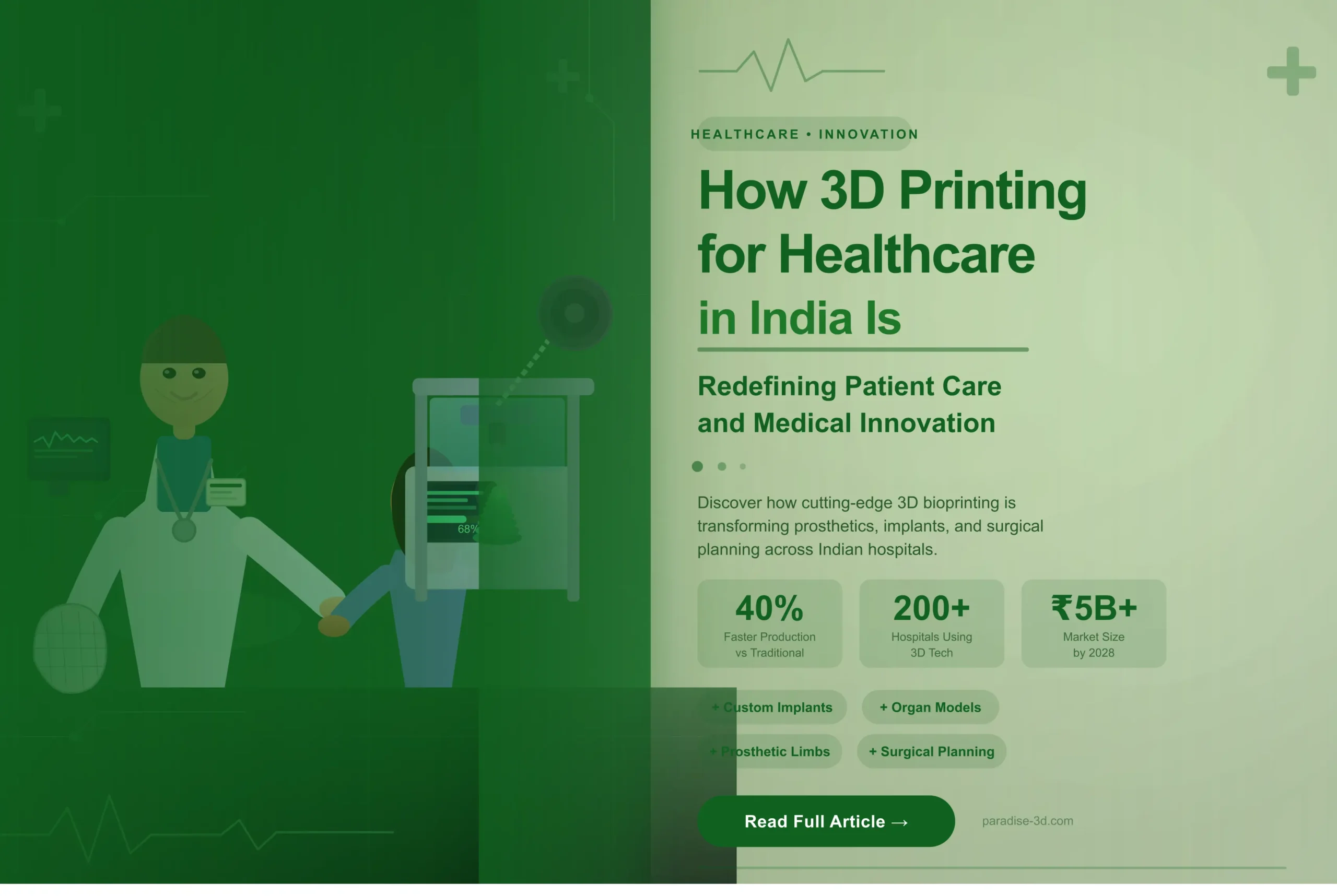
How 3D Printing for Healthcare in India Is Redefining Patient Care and Medical Innovation
India’s healthcare system serves over 1.4 billion people, yet patient-specific solutions remain scarce. Standard implants don’t fit every anatomy. Surgical preparation is often limited by the models available. Prosthetics remain expensive and inaccessible for millions. These are not distant problems—they are daily realities faced by hospitals, doctors, and patients across the country.
3D printing for medical in India is changing this equation. By enabling the creation of customized medical devices, anatomical models, and surgical tools at a fraction of traditional costs, additive manufacturing is finally bringing precision medicine within reach.
In this blog, we cover what 3D printing in healthcare means, how it is growing in India, its key applications, materials, regulatory landscape, real-world examples, and why 3D Paradise is the partner of choice for Indian healthcare organizations.
What Is 3D Printing in Healthcare?
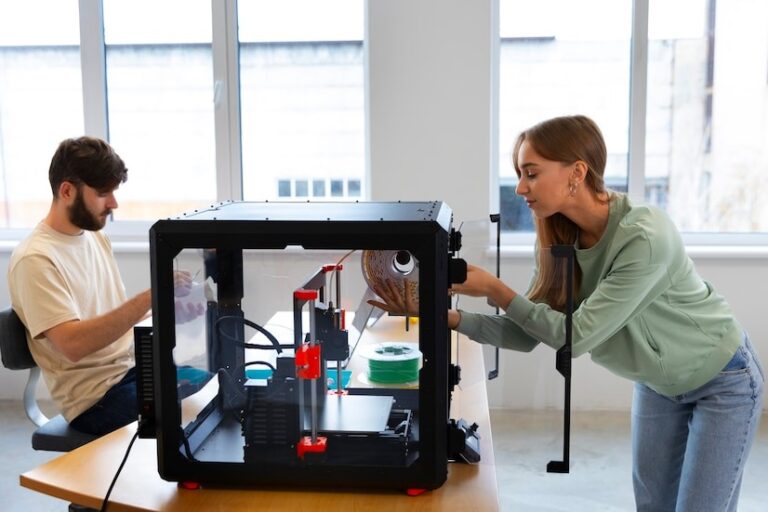
3D printing – also called additive manufacturing – builds physical objects layer by layer from a digital design file. In the healthcare context, this means converting CT scans, MRI data, or CAD designs into tangible medical tools and devices with exceptional precision.
Unlike traditional manufacturing, 3D printing produces patient-specific outputs without expensive tooling or mold costs. A surgeon can hold a replica of a patient’s spine before entering the operating theater. A biomedical engineer can iterate on a prosthetic socket overnight. A medical startup can prototype a new device in days instead of months.
This technology sits at the intersection of digital health, personalized medicine, and advanced manufacturing—making it one of the most impactful innovations in the healthcare industry today.
Growth of 3D Printing in the Indian Healthcare Industry
The 3D printing healthcare industry in India is expanding rapidly. Driven by government initiatives like Make in India, the National Medical Devices Policy 2023, and growing investment in digital health infrastructure, Indian hospitals and medtech companies are increasingly adopting additive manufacturing.
$2.3B+
Projected Indian medtech market by 2027
25%+
Annual growth in 3D printing adoption across Indian hospitals
₹500 Cr+
Estimated 3D printing healthcare segment in India (2024)
Top 5
India among fastest-growing additive manufacturing markets in Asia-Pacific
Leading institutions like AIIMS Delhi, Manipal Hospitals, and the Indian Institute of Technology campuses have already integrated 3D printing into surgical planning, research, and device development. The government’s PLI scheme for medical devices further incentivizes domestic manufacturing-and 3D printing is a key enabler.
Key Applications of 3D Printing in the Medical Field
Patient-Specific Implants
One of the most impactful uses of 3D printing medical devices is producing implants tailored to an individual patient’s anatomy. Titanium spinal cages, cranial plates, orthopedic joint replacements, and maxillofacial implants can be designed directly from a patient’s CT scan, resulting in better fit, reduced surgery time, and faster recovery.
Example: A patient with a complex pelvic fracture can receive a 3D-printed titanium implant that matches their exact bone structure – something impossible with off-the-shelf components.
Surgical Guides and Planning Models
Surgeons use 3D-printed anatomical models to rehearse complex procedures before the first incision. Cutting guides — precision jigs that attach directly to bone — help ensure accuracy during orthopaedic and spinal surgeries. This reduces intraoperative errors and improves outcomes, particularly in resource-constrained settings.
Prosthetics and Orthotics
3D printing for medical devices like prosthetic limbs is transforming accessibility in India. Traditional prosthetics can cost ₹1–5 lakh and take weeks to fabricate. With additive manufacturing, functional hand and arm prostheses can be produced for as little as ₹10,000–₹30,000 in days, opening access to populations previously left behind.
Medical Training Models
Medical colleges and simulation centres use 3D-printed anatomical models-hearts, lungs, tumors, and vascular structures-for student training, patient communication, and procedure rehearsal. These replicas closely mimic the feel and structure of real tissue, making training more effective and realistic.
Bioprinting – The Future Frontier
Bioprinting—printing with living cells and biomaterials—remains an emerging area, but Indian research institutions are actively working on 3D-printed skin grafts, cartilage scaffolds, and organ-on-chip models. While fully functional organ printing is still years away, the groundwork being laid today will define the next decade of regenerative medicine in India.
Benefits of 3D Printing for Medical Devices
| Benefit | What It Means for Indian Healthcare |
|---|---|
| Customisation | Implants and devices match each patient’s anatomy precisely |
| Speed | Devices produced in 24–72 hours vs. weeks with traditional methods |
| Cost efficiency | Reduces reliance on expensive imported devices; supports domestic production |
| Design freedom | Complex geometries impossible with CNC or casting become achievable |
| Reduced waste | Additive process uses only the material needed |
| Prototyping speed | Startups and R&D teams can iterate designs rapidly |
| Improved outcomes | Better-fitting devices mean fewer complications and shorter recovery times |
Real-World Use Cases in India
AIIMS Delhi – 3D-Printed Skull Implants
AIIMS Delhi has performed surgeries using 3D-printed titanium cranial implants for patients with complex skull defects. Designed from CT data, these implants fit perfectly and dramatically reduce surgical complexity.
IIT Madras – Low-Cost Prosthetic Hands
Researchers at IIT Madras developed a 3D-printed, body-powered prosthetic hand costing under ₹8,000 — making functional prosthetics accessible to amputees across rural India.
Manipal Hospitals – Surgical Pre-Planning Models
Manipal Hospitals has used patient-specific 3D-printed heart and vascular models for complex cardiac and neurosurgical pre-operative planning, reducing time in theatre and improving surgeon confidence.
These examples illustrate that 3D printing for healthcare in India is no longer experimental — it is clinical reality, deployed at some of the country’s most respected institutions.
Materials Used in Medical 3D Printing
| Material | Applications | Key Property |
|---|---|---|
| Titanium (Ti-6Al-4V) | Implants, spinal cages, cranial plates | Biocompatible, osseointegration |
| Medical-grade Nylon (PA12) | Surgical guides, orthotics, prosthetics | Lightweight, sterilisable |
| Biocompatible Resins | Anatomical models, dental guides | High resolution, smooth surface |
| PEEK | Spinal and cranial implants | Radiolucent, bone-like stiffness |
| PLA / ABS (medical grade) | Training models, temporary fixtures | Cost-effective, wide availability |
| Bioinks (hydrogels & cells) | Tissue scaffolds, bioprinting | Living cell compatibility |
Challenges and Regulations in India
Despite rapid growth, 3D printing for medical in India faces real challenges that healthcare professionals must navigate:
- Regulatory clarity: The Central Drugs Standard Control Organisation (CDSCO) regulates medical devices under the Medical Devices Rules 2017. Custom 3D-printed implants typically require Class C or D device approval, which demands rigorous documentation and biocompatibility testing.
- Material certification: Not all 3D printing materials are cleared for in-body use. Hospitals must ensure their vendors use ISO 10993-certified biocompatible materials.
- Quality validation: Unlike batch-manufactured devices, each custom print must be individually validated — requiring robust quality management systems.
- Skilled workforce: Biomedical engineers and clinical specialists trained in additive manufacturing remain relatively scarce, though this is changing rapidly with new curricula and upskilling programmes.
- Awareness gaps: Many smaller hospitals and clinics are still unaware of the practical applications and cost advantages that 3D printing offers.
Partnering with an experienced provider who understands Indian regulatory requirements is therefore essential for any hospital or medtech company entering this space.
Future of 3D Printing in the Healthcare Industry
The trajectory of 3D printing for healthcare in India over the next five to ten years is defined by several converging trends:
- Point-of-care manufacturing: Hospitals will maintain in-house 3D printing labs capable of producing surgical guides and simple devices on demand.
- AI-driven design: Machine learning will automate the conversion of scan data into print-ready implant designs, reducing turnaround from days to hours.
- Bioprinting scale-up: Commercial skin grafts and cartilage scaffolds will enter clinical trials in India within the decade.
- Telemedicine + 3D printing: Remote diagnostic data will feed directly into printing workflows, enabling patient-specific devices to be produced locally even for patients in Tier 2 and Tier 3 cities.
- Government manufacturing push: India’s ambition to become a global medical device hub, backed by the PLI scheme, will drive further adoption of additive manufacturing as a competitive differentiator.
Why Choose 3D Paradise for Healthcare 3D Printing
3D Paradise is India’s dedicated advanced manufacturing partner for healthcare organisations seeking precision, speed, and regulatory-aware 3D printing solutions.
- Medical-grade materials: We work exclusively with biocompatible, certified materials suitable for surgical and clinical applications.
- End-to-end expertise: From CT/MRI scan processing and design optimisation to final print and post-processing, we manage the full workflow.
- Regulatory guidance: Our team understands CDSCO requirements and helps clients navigate documentation for custom device approvals.
- Fast turnaround: We deliver surgical models and guides in 24–72 hours — because time matters in clinical settings.
- Scalable for all needs: Whether you are a large multi-specialty hospital, a medical startup prototyping your first device, or a research institution running trials, we scale to your requirements.
Explore our healthcare 3D printing services or contact our team to discuss your project.
Frequently Asked Questions
1) What is 3D printing in healthcare in India?
3D printing in healthcare in India is the process of creating patient-specific medical devices, implants, surgical guides, and anatomical models from digital scan data to improve treatment accuracy and reduce surgery time.
2) What are the main applications of 3D printing in healthcare?
The main applications of healthcare 3D printing include custom implants, prosthetic limbs, surgical planning models, dental devices, medical training models, and rapid prototyping for new medical devices.
3) Is 3D printing safe for medical use in India?
Yes, medical 3D printing is safe in India when devices are produced using certified biocompatible materials and approved under regulations set by the Central Drugs Standard Control Organisation.
4) How much does 3D printing cost for medical applications in India?
The cost of medical 3D printing in India typically ranges from ₹5,000 for anatomical models to ₹3,00,000 or more for custom implants, depending on material, size, and device complexity.
5) How long does it take to produce a 3D printed medical device?
Most 3D printed medical devices such as surgical guides or anatomical models can be designed, printed, and delivered within 24 to 72 hours after receiving validated CT or MRI scan data.
6) What materials are commonly used in medical 3D printing?
Common materials used in medical 3D printing include titanium for implants, medical-grade nylon for surgical guides, PEEK for spinal devices, and biocompatible resins for anatomical and dental models.
7) Can hospitals in India use 3D printing without buying machines?
Yes, hospitals in India can use healthcare 3D printing services through specialized providers like 3D Paradise, allowing them to produce medical devices without investing in expensive in-house equipment.
8) What are the benefits of 3D printing in healthcare?
The key benefits of 3D printing in healthcare include faster production, lower manufacturing costs, patient-specific customization, improved surgical accuracy, and reduced recovery time for patients.
9) Which hospitals in India are using 3D printing technology?
Leading hospitals and institutions such as All India Institute of Medical Sciences and Manipal Hospitals are actively using 3D printing for surgical planning, implants, and medical research.
10) What is the future of 3D printing in healthcare in India?
The future of healthcare 3D printing in India includes hospital-based printing labs, AI-driven medical device design, and advanced bioprinting technologies for tissue engineering and regenerative medicine.