SLA vs FDM — Which 3D Printing Technology is Better in 2026?
From concept validation to functional prototype manufacturing, choosing the right 3D printing technology can directly impact product quality, development speed, and production cost. In 2026, SLA and FDM remain the two most widely used additive manufacturing technologies for engineers, startups, product designers, and industrial manufacturers.
While both technologies build parts layer by layer, their capabilities are completely different. SLA 3D printing delivers exceptional surface finish, fine detail accuracy, and precision resin prototypes, whereas FDM 3D printing is known for durable thermoplastic parts, affordable production, and faster large-scale prototyping.
At 3D Paradise, we help businesses select the right 3D printing process based on application, material requirements, dimensional accuracy, strength, and manufacturing goals.
If you are comparing SLA vs FDM for rapid prototyping, engineering components, product development, or industrial manufacturing, this guide explains the real differences in print quality, materials, cost, durability, precision, and production performance.
What is SLA 3D printing?
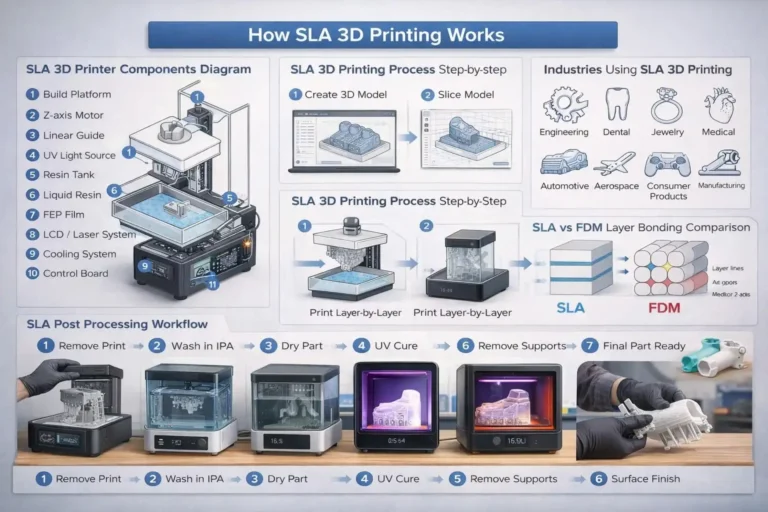
SLA 3D printing, also called stereolithography, is a high-resolution additive manufacturing process that uses a UV laser to cure liquid photopolymer resin layer by layer.
The laser selectively solidifies resin according to a digital CAD model until the final part is complete.
Because SLA printing uses extremely fine layer resolution, it produces the following:
- Smooth surface finish
- Sharp edges
- Fine details
- Tight dimensional accuracy
- Professional-quality prototypes
Industries commonly use SLA printing for:
- Medical models
- Dental applications
- Jewelry casting patterns
- Transparent prototypes
- Engineering validation
- Cosmetic product prototypes
Key Advantages of SLA Printing
- High-resolution printing
- Excellent dimensional accuracy
- Superior surface quality
- Transparent resin capability
- Fine feature reproduction
- Complex geometry manufacturing
What is FDM 3D printing?
FDM, or Fused Deposition Modeling, is a filament-based 3D printing process that melts thermoplastic material and deposits it layer by layer through a heated nozzle.
Unlike SLA printing, FDM uses solid filament materials such as:
- PLA
- ABS
- PETG
- Nylon
- TPU
FDM printing is widely used because it offers:
- Lower production cost
- Strong mechanical parts
- Faster prototyping
- Large-format printing
- Functional prototype manufacturing
FDM remains one of the most cost-effective rapid prototyping technologies for industrial and commercial applications.
Key Advantages of FDM Printing
- Affordable manufacturing
- Strong thermoplastic components
- Faster production for large parts
- Wide material availability
- Lower post-processing requirements
Read also: SLA vs. FDM vs. SLS: Which 3D Printing Technology is Right for You?
Surface Finish Comparison
Surface quality is one of the biggest differences between SLA and FDM.
SLA Surface Finish
SLA produces extremely smooth surfaces with almost invisible layer lines. This makes it ideal for:
- Presentation models
- Cosmetic prototypes
- Medical components
- Jewelry patterns
- Transparent parts
FDM Surface Finish
FDM parts usually show visible layer lines because molten filament is deposited through nozzle extrusion.
Surface quality depends on:
- Layer height
- Nozzle size
- Material type
- Print settings
For highly cosmetic applications, FDM often requires sanding and finishing.
Winner: SLA
SLA clearly delivers better surface finish and visual quality.
Accuracy & Precision Comparison
Dimensional accuracy matters when prototypes require exact fitting, assembly testing, or engineering validation.
SLA Accuracy
Industrial SLA systems can achieve tolerances around:
- ±0.1 mm
- Layer resolution as fine as 25 microns
This makes SLA ideal for precision prototyping and detailed geometries.
FDM Accuracy
FDM printers typically provide:
- ±0.2 mm to ±0.5 mm tolerances
Accuracy depends heavily on machine calibration and material shrinkage.
Winner: SLA
For engineering-grade precision and fine details, SLA outperforms FDM.
Material Comparison
Material selection plays a major role in choosing the right technology.
SLA Materials
SLA printing uses photopolymer resin materials including:
- Standard resin
- Tough resin
- Flexible resin
- Clear resin
- Dental resin
- High-temperature resin
These materials provide excellent detail quality and smooth finishes.
FDM Materials
FDM supports a wider range of thermoplastic materials such as:
- PLA
- ABS
- PETG
- Nylon
- Carbon-fiber composites
- TPU
These materials offer better mechanical strength and durability.
Winner: FDM
FDM provides greater material variety and stronger functional parts.
Strength & Durability
Mechanical performance is another important factor in industrial prototyping.
SLA Strength
SLA parts provide excellent detail but may become brittle under heavy mechanical stress depending on the resin used.
Tough engineering resins improve impact resistance, but SLA still focuses more on precision than heavy-duty performance.
FDM Strength
FDM parts generally perform better in:
- Mechanical testing
- Functional applications
- Structural components
- Industrial tools
Materials like ABS and Nylon provide excellent durability.
Winner: FDM
For strong functional prototypes, FDM performs better.
Cost Comparison – SLA vs FDM
Cost often influences the final manufacturing decision.
SLA Printing Cost
SLA printing usually costs more because of:
- Expensive resin materials
- UV curing systems
- Post-processing requirements
- Higher machine cost
However, the superior finish reduces finishing labor in many applications.
FDM Printing Cost
FDM is significantly more affordable because:
- Filament materials cost less
- Machines are cheaper
- Faster production reduces labor
- Minimal post-processing is needed
Winner: FDM
FDM remains the more budget-friendly 3D printing technology.
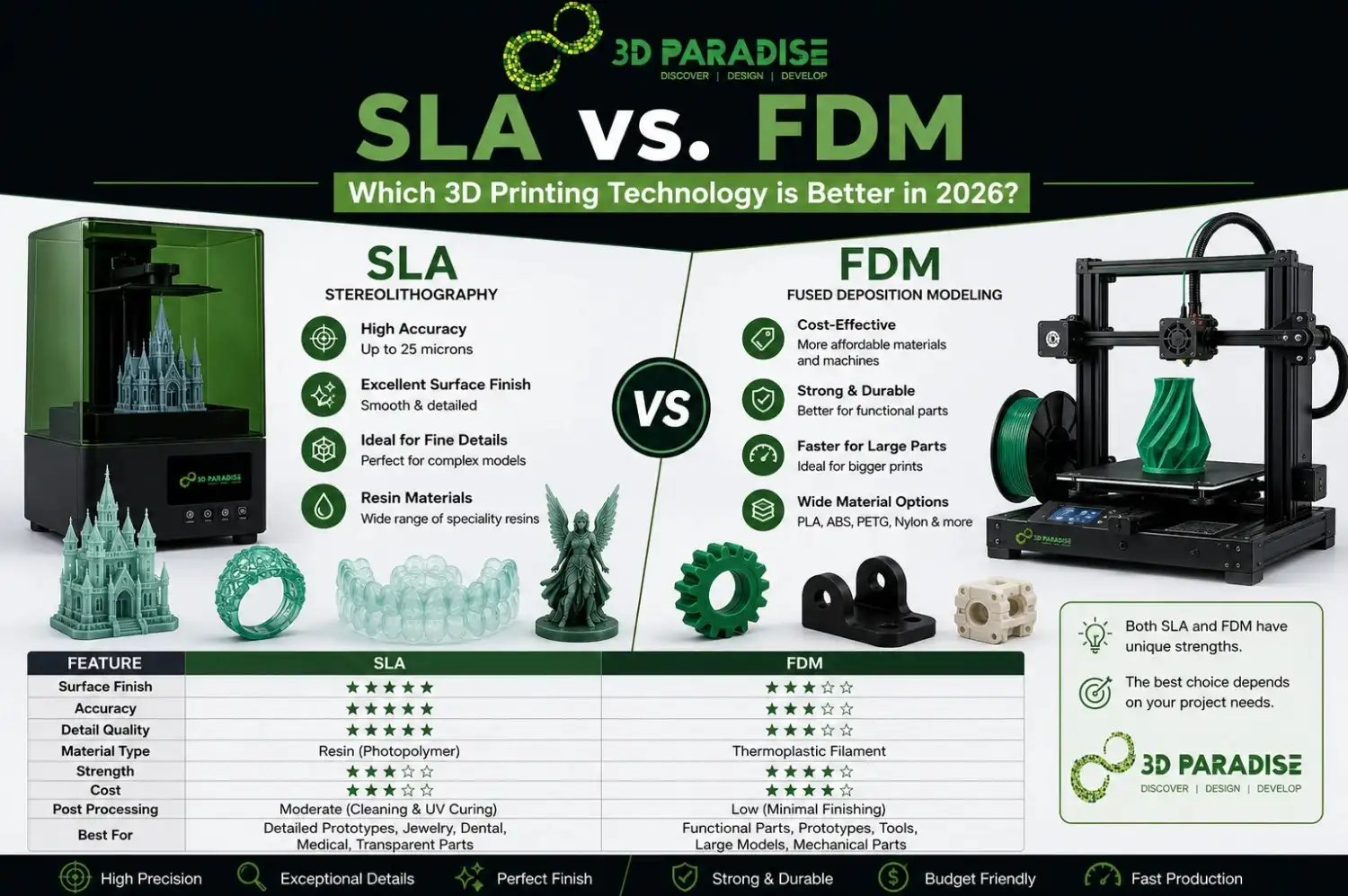
SLA vs FDM Comparison Table
| Feature | SLA | FDM |
|---|---|---|
| Surface Finish | Excellent | Moderate |
| Accuracy | Very High | Medium |
| Detail Quality | Exceptional | Average |
| Material Type | Resin | Thermoplastic Filament |
| Strength | Medium | High |
| Cost | Medium–High | Low |
| Post Processing | Moderate | Low |
| Best For | Detailed Prototypes | Functional Parts |
Read Also: FDM vs. SLA vs. SLS: Comparison Right 3D Printing 2025
When Should You Choose SLA Printing?
SLA 3D printing is the better choice when your project requires:
- Smooth cosmetic surfaces
- Fine detail accuracy
- Transparent prototypes
- Medical models
- Dental applications
- Jewelry master patterns
- Precision engineering validation
SLA is widely preferred for presentation-quality prototypes and high-detail industrial applications.
When Should You Choose FDM Printing?
FDM works best for:
- Functional prototypes
- Mechanical testing
- Large parts
- Low-cost production
- Industrial fixtures
- Durable engineering components
For businesses prioritizing affordability and strength, FDM offers better long-term value.
SLA vs FDM for Rapid Prototyping
Both technologies play a major role in rapid product development.
SLA for Rapid Prototyping
SLA helps product teams:
- Validate designs quickly
- Produce highly detailed models
- Improve presentation quality
- Test small assemblies
- Develop precision prototypes
FDM for Rapid Prototyping
FDM supports:
- Fast concept iterations
- Affordable prototype manufacturing
- Functional product testing
- Large-format prototypes
- Industrial manufacturing workflows
Many manufacturers use both technologies together depending on the development stage.
Which 3D Printing Technology is Better in 2026?
There is no universal winner between SLA and FDM 3D printing.
The right technology depends entirely on your project requirements.
Choose SLA If You Need:
- High precision
- Smooth surface finish
- Fine details
- Transparent parts
- Presentation-quality prototypes
Choose FDM If You Need:
- Strong mechanical parts
- Affordable production
- Large-format printing
- Functional testing
- Faster low-cost manufacturing
For many engineering and industrial workflows, combining SLA and FDM delivers the best balance between precision, strength, speed, and cost.
Frequently Asked Questions
Which is more accurate, SLA or FDM?
SLA is generally more accurate because stereolithography uses UV laser curing with much finer layer resolution.
Is SLA stronger than FDM?
No. FDM typically produces stronger and more durable parts because thermoplastic materials provide better mechanical strength.
Why is SLA more expensive?
SLA printing involves higher resin costs, UV curing systems, and more post-processing compared to FDM manufacturing.
Which technology is better for prototypes?
SLA is better for cosmetic and precision prototypes, while FDM is better for functional and low-cost prototypes.
Is resin printing better than filament printing?
Resin printing provides better detail and surface quality, while filament printing offers stronger parts and lower production cost.
Final Thoughts
The SLA vs FDM debate is not about which technology is universally superior. It is about selecting the right manufacturing process for your application.
SLA dominates when precision, smooth surfaces, and fine details matter most. FDM remains the preferred choice for durable parts, affordable production, and functional engineering applications.
Before choosing a technology, evaluate:
- Surface quality requirements
- Mechanical strength needs
- Production budget
- Prototype functionality
- Material performance
- Manufacturing timelines
The right decision improves product quality, reduces development cost, and accelerates product launch timelines.